

Earth 3.0
- 1. Threats to Our Earth and Humanity
- 2. II. Solution - Nanorobots
- 3. III. The Beehive as a Model
- 4. IV. Phase Two, Further Development into the Depths
- 5. V. The Control of Earth's Magma and Its Energy Generation
Threats to Our Earth and Humanity ^^^up
Loss of the Moon:
The Moon is slowly drifting away from Earth, which will have significant long-term effects on tides and climate.
Asteroid and Comet Impacts:
A large asteroid or comet could strike Earth again, causing massive destruction similar to or worse than the event that wiped out the dinosaurs.
Earthquakes:
The movement of tectonic plates causes earthquakes, which trigger tsunamis and other natural disasters.
Shifting of Earth's Plates:
Continental drift leads to long-term changes in the Earth's surface, causing catastrophic earthquakes.
Climate Change:
Global warming causes extreme weather events, rising sea levels, and the melting of glaciers and polar caps.
Ice Ages:
Long-term climate changes could trigger a new ice age, drastically altering living conditions.
Ozone Depletion and Pollution:
The destruction of the ozone layer and atmospheric pollution endanger the health of all living beings.
Our atmosphere is exposed to many inferno scenarios. Without an atmosphere, life ends instantly!
Energy Crises:
The depletion of fossil fuels and the slow transition to renewable energy could lead to global energy crises.
Food Shortages:
A growing world population and climate change threaten food production.
Inequality:
Social inequality and poverty exacerbate social tensions and lead to instability.
Technological Accidents:
Accidents in nuclear facilities or with other dangerous technologies could have devastating effects.
It is important to be aware of these threats and take measures to minimize their impact. Human progress and global cooperation are crucial to overcoming these challenges.
II. Solution - Nanorobots ^^^up
The solution to our problems, which has been swirling in my mind, is too complex and not feasible with today's technology. Even if we had started before my birth, I would not live to see it.
I will now attempt to briefly present the solution. This will not be easy, and if you are conservative, reading this may not be worthwhile.
The idea that rich people can hide deep in the mountains or escape to Mars, as recently planned, to avoid an inferno is naive.
Approach: Transforming the Earth.
We will not be able to achieve this with excavators and cement.
If we look at our Earth, the few cities we have built are nothing compared to the forests, deserts, mountains, and oceans.
We have barely scratched the Earth's surface, yet the environment is already becoming unbalanced. We cannot continue as we have.
Therefore, we should develop a nanorobot with the following properties:
Self-replication:
It multiplies like a virus.
Self-reproduction:
It consumes sand and reproduces itself.
Connection:
After several reproduction cycles, it connects with other nanorobots that have the same lifecycle and then becomes a building element.
Network:
Each nanorobot has a unique ID and is connected to a network.
III. The Beehive as a Model ^^^up
In a CAD system, the Earth's crust was architecturally reconstructed. Hexagonal rooms were built adjacent to each other, exhibiting the following features:
- **Side length**: 10,000 meters
- **Height**: 2,000 meters
- **Wall thickness**: 300 meters
These rooms encompass both the floor and ceiling. The construction material consists of the described nano-robots.
The hexagonal walls have cavities, and the usable area of a wall is approximately:
10,000m x 300m x 2,000m
= 6 cubic kilometers
In comparison, Hong Kong has about 55 cubic kilometers of space utilization. Munich would fit into a single hexagonal wall.
A hexagonal wall can have over 500 floors, around 1,000,000sqm!
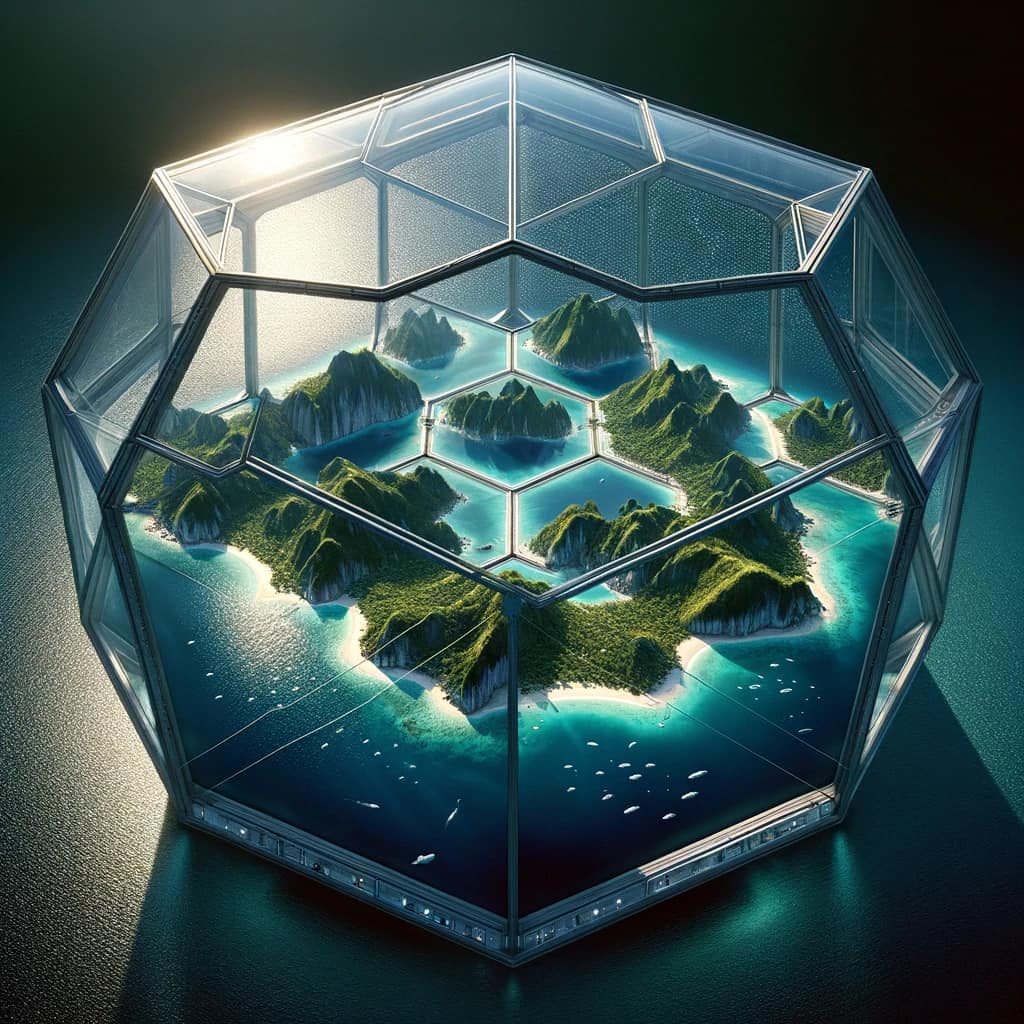
The Earth has an area of about 510 million square kilometers. This area would accommodate approximately 2 Million hexagonal rooms, with each room covering around 260 square kilometers to be returned to nature.
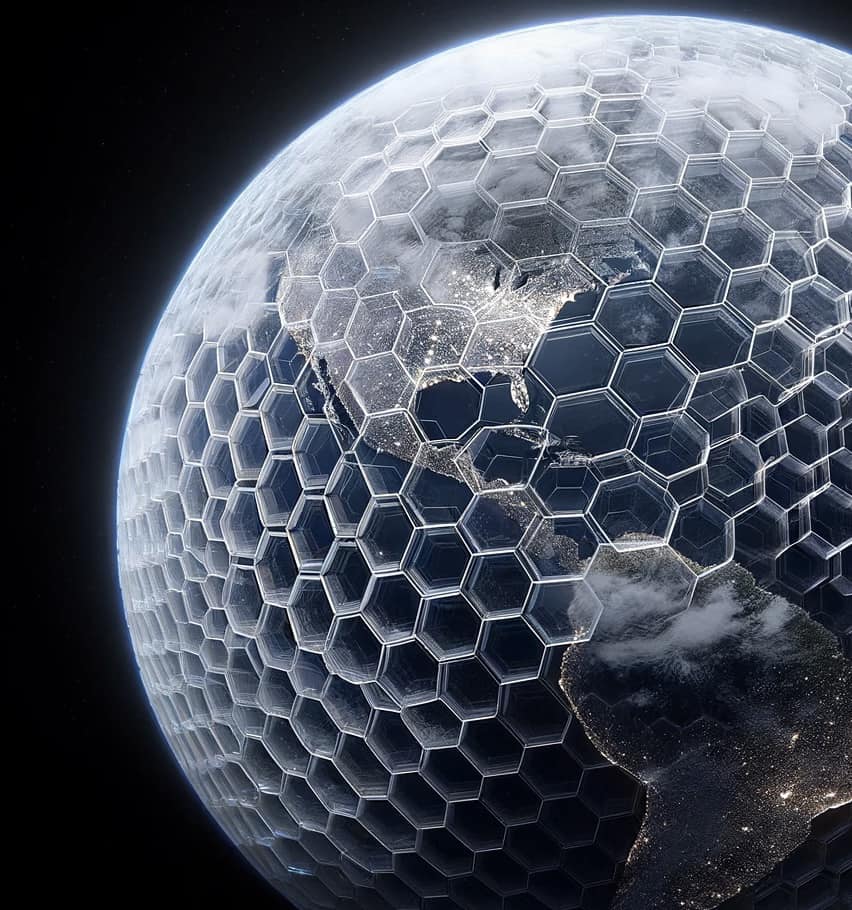
The nano-robot would reconstruct the Earth's crust by building 60 million massive hexagonal rooms according to the CAD plan. Afterwards, the Earth would have a new, functional, strengthened, and sealed shell.
IV. Phase Two, Further Development into the Depths ^^^up
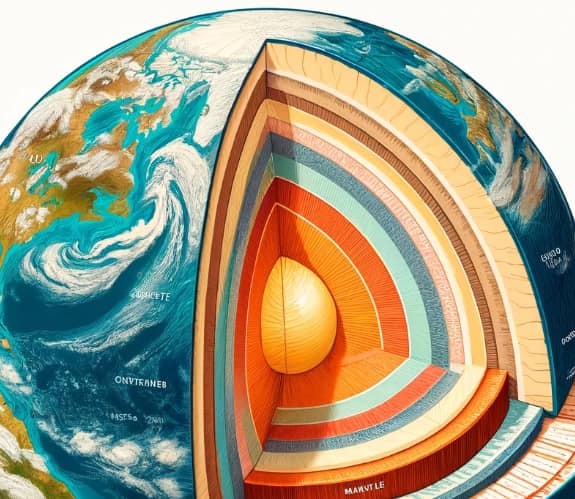
If we take another step in our vision, the nano-robots could not only build on the surface but also continue construction at depths ranging from 2 to 50 kilometers. They would construct additional layers of hexagonal rooms, possibly with a lower ceiling height. This construction could continue until the nano-robots create an inner shell that reaches the Earth's magma.
In the CAD plan, long- and short-range connections through tunnels within the floors and axes of the hexagonal rooms are also considered. Flying would only be necessary outside this new shell. (Transporting goods and people via vehicles over long distances should not be overestimated if teleportation becomes a reality.)
It is advisable to maintain the original atmosphere. However, approximately 60 Million separate atmospheres could be created in the individual hexagonal rooms, which could be individually controlled and regulated.
Our goal is to lose nothing. Landscapes, seas, and lakes will be restored and returned to animals, fish, and insects. These natural areas should no longer be burdened by factories or houses but remain preserved in their natural state. However, some animal species will struggle, as they would now have to live on a maximum area of 260 km².
All cells are hermetically sealed and protected. Human work will be required to manage 60 Million terrariums and aquariums.
Humans live in the walls of the hexagonal cells. On the entire surface of the hexagonal walls, which are 300 meters wide and 10,000 meters long, living spaces, meeting centers, workplaces, and storage areas are created. These spaces span across hundreds of levels.
- **Living Space**:
In the walls of the hexagonal cells, there are apartments and community rooms. In open areas, their residents look down at restored nature or gaze into an aquarium of the sea from the living room window.
- **Meeting Centers**:
Areas for social interactions, business centers, and community activities are also integrated.
- **Workplaces and Storage**:
Some areas are designated for workplaces and storage.
- **Water and Sea Cells**:
Certain hexagonal cells store controlled clean water or form seas that provide the residents with an undisturbed home.
- **Security Cells**:
Some cells are locked and specifically designed for working with hazardous goods.
Energy is generated through three main processes: solar energy is collected by the solar nano-robots on the surface of the outer shell, magma heat energy is converted at the inner shell, and waste is burned in the magma. Waste disposal is finally off the table.
During the Earth's transformation, the nano-robots consumed sand. All other elements and raw materials were mined and collected.
V. The Control of Earth's Magma and Its Energy Generation ^^^up
A crucial aspect of our technology is penetrating to the Earth's magma. This presents an immense technical challenge, particularly controlling the gap between the final room level and the magma. However, the benefits are enormous: we tap into a huge energy source and likely significantly reduce our waste problem. (Energy reserve magma mantle, about 5 billion years with current load)
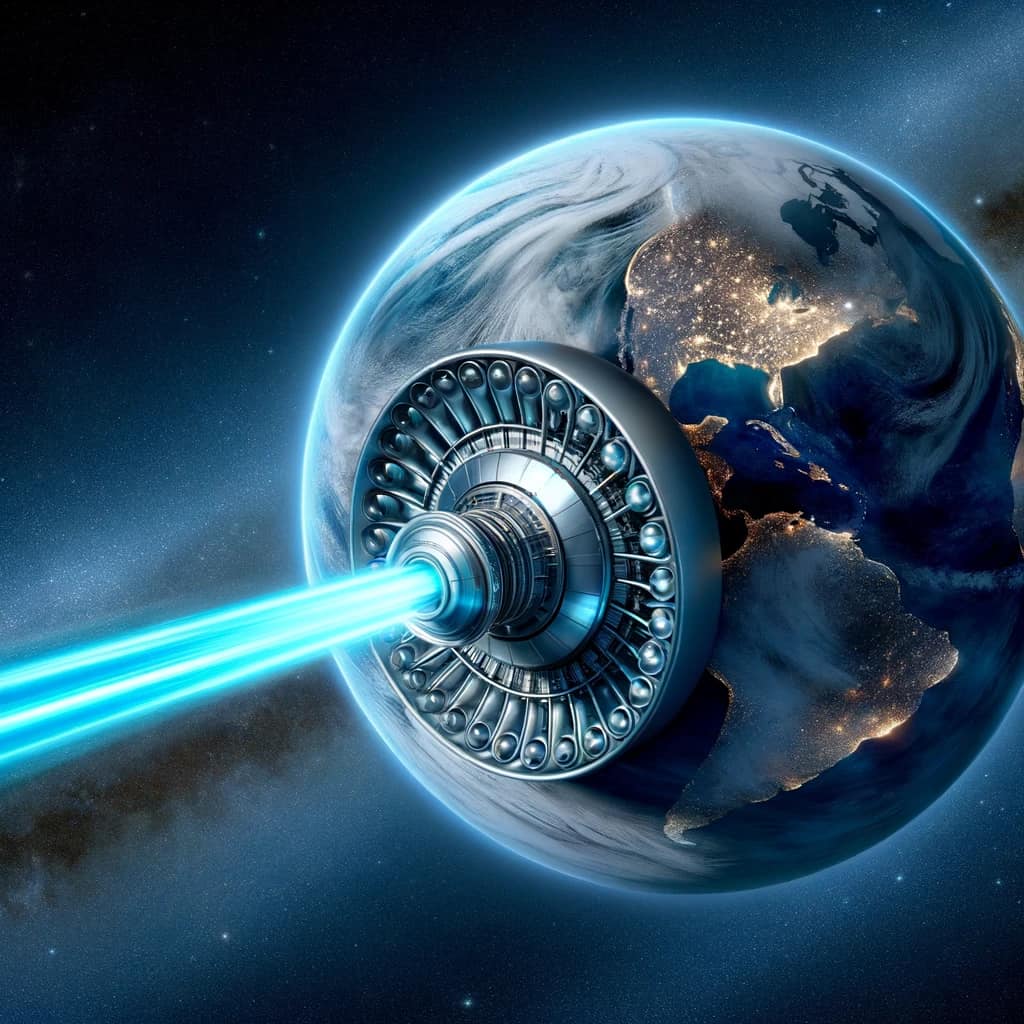
Part of this energy will be used for several gigantic drives that control the Earth's rotation and alter our trajectory in space.
What threats, as we described earlier, still exist?
- **Volcanic Eruptions, Earthquakes, Storms, Tsunamis:**
These natural disasters are neutralized by our control over the Earth and its processes.
- **Climate:**
The climate is specifically controlled in each of the 60 Million rooms.
- **Epidemics:**
The spread of epidemics is significantly hampered by the separation of the rooms.
- **Asteroid Impacts:**
Thanks to our technology, we can perform evasive maneuvers and prevent collisions.
- **Sun's Death:**
A new sun could be visited.
In particular, the supply of energy, food, clean water, and oxygen is ensured. Due to the highly specialized cells, horizontal food production, and controlled drinking water, a higher population density on Earth becomes conceivable. Socially, the new environment will raise questions, and boundaries, countries—will they become obsolete?
Before we transform our Earth, we first test the nano-robot on our moon. After a successful test, the moon will be populated and remain in our vicinity.
Although it sounds incredible, the nano-robot will systematically break down the Earth's crust. Each nano-robot is programmed to be individually addressable and is controlled by the architect network.
The extraction of special elements such as gold, rare earths, and diamonds, raw materials like oil and gas, will be found and provided by the robot as it progresses.
Spanning the ocean will certainly pose a challenge.
In idle mode, the nano-robot functions as a building element and remains in constant communication with our AI Super Controller Computer (kiSCC) of the architect network.
Each nano-robot can glow in any color, be transparent like glass, collect radiation energy, or transform the ceiling of a hexagon into a giant OLED TV panel. This way, we can choose between a cinema on the walls or a simulated or real sunset on the ceiling.
Damages or special structural changes are detected by the network, and the nano-robots are deployed for repairs.