The Human Version 3.0
- 1. Visions of an Infinite Existence through Technological Evolution
- 2. Infinite Life through Digital Existence
- 3. Physical and Mental Adaptations
- 4. Societal and Ethical Implications
- 5. Future Challenges
- 6. Conclusion
- 7. Supplementing Teleportation and Digital Consciousness
Visions of an Infinite Existence through Technological Evolution ^^^up
In today's time, marked by rapid technological advancements, humanity may be on the verge of a radical transformation of its biological and social nature. The concept of "Human V3.0," characterized by digital and nanobiotechnological innovations, raises fundamental questions: What would our lives look like if we could overcome the biological limits of the human body and mind? In this article, we explore the visionary aspects of such a new human, including the potential immortality of consciousness, adaptability to extreme environments, and the challenges these changes could pose for our societal structures.
Infinite Life through Digital Existence ^^^up
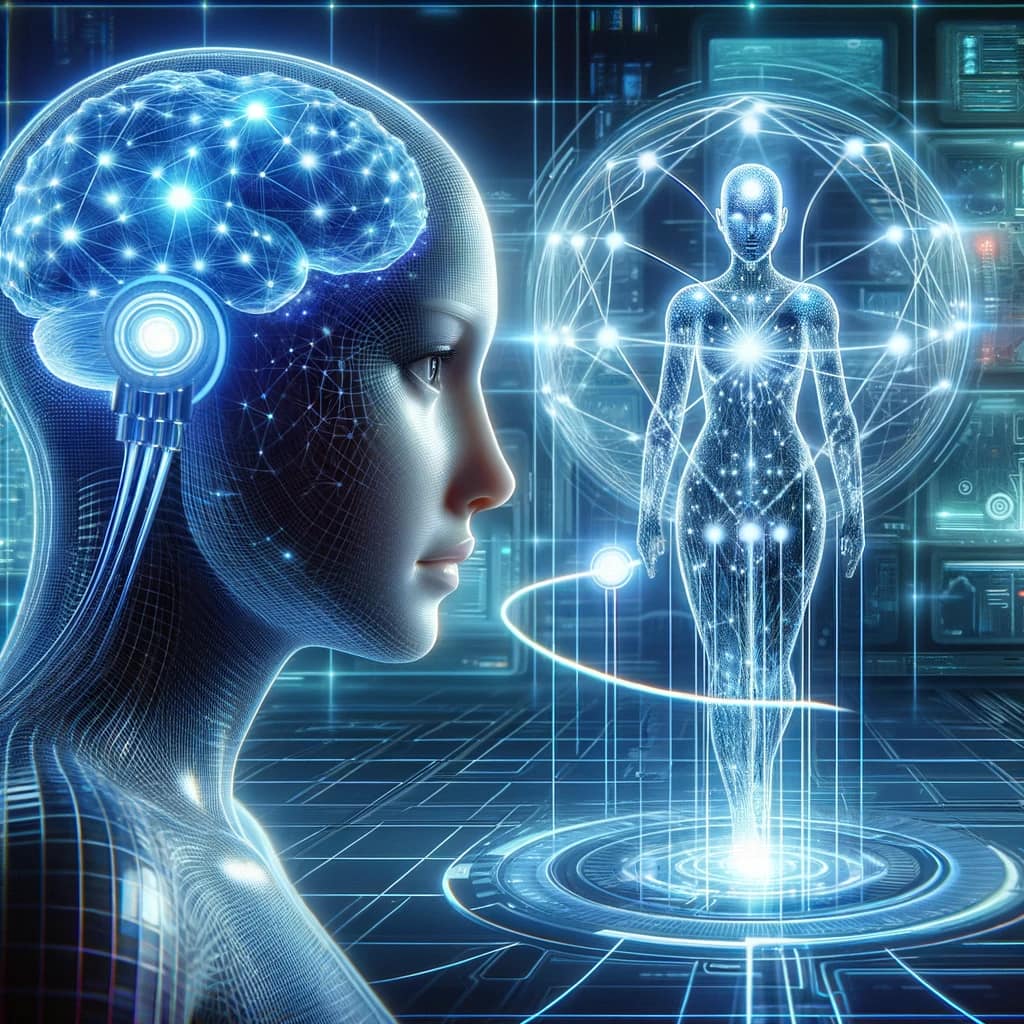
The idea of digitizing human consciousness and storing it in the cloud to create a backup that can be transferred to a new body when needed opens up the concept of nearly infinite lifespan. This would not only fundamentally change human experience but also bring about significant new challenges regarding security and privacy. The role of Artificial Intelligence (AI) would be crucial here, as it would need to take control, security, and protection of the consciousness data stored in the cloud.
Physical and Mental Adaptations ^^^up
The physical adaptations for the new human would be extensive to enable survival and mobility in extreme environments such as space or the depths of the oceans. Mechanisms like photosynthesis-like processes could eliminate the need for traditional food intake, and the structure of the human body would need to be able to dynamically adjust to different gravitational forces and environments. The need for oxygen would end. The ability to change one's location using advanced technologies like "beaming" is another speculative but fascinating possibility.
Societal and Ethical Implications ^^^up
Societal structures – from family models to educational systems and the labor market – would be profoundly changed by the possibility of infinite lifespans. Marriage and partnership could take on more flexible forms, and the definition of family and parenthood could be renegotiated. Additionally, ethical, legal, and psychological challenges would bring the need for new regulations and profound public discourse.
Future Challenges ^^^up
The realization of such a vision requires not only scientific breakthroughs but also a careful consideration of the ethical, legal, and social issues that such a fundamental change to human existence would bring. Considerations for potential immortality and enhanced human abilities would need to be accompanied by global discussions and regulations to ensure that such technologies are applied sustainably and justly.
Conclusion ^^^up
The vision of the new human is an exciting, but also challenging idea. It offers enormous possibilities for individual and, in particular, collective growth, but at the same time, it turns our current way of life and values upside down. How humanity shapes this transition will depend not only on technological possibilities but also on collective ethical reflection.
Supplementing Teleportation and Digital Consciousness ^^^up
Unique Existence:
An individual exists only once at any given time.
Consciousness Shutdown:
At the current location, the person shuts down their consciousness. The last sensations and experiences are frozen and stored in a central cloud at light speed.
Nano-Robot Body:
The consciousness-free nano-robot body can either be parked at a supply system or dissolved. The parking facility is located by the nano-robot itself. The free nano-robot can be used by other users.
Destination:
At the destination, a standard nano-robot body is activated, and the previously stored consciousness is transferred and resumed at light speed by the AI.
No material transfer occurs.
Body Adjustments:
After the transfer, the person can retrieve stored design adjustments or modify the body for the new environment, e.g., swim and dive modifications on a water planet. Similarly, modifications for staying in space or on planets with differing gravity.
Externally, each individual can freely choose their human form.
Even if food intake in the traditional sense is no longer necessary, they can still continue this ceremony and feel the same, but perhaps no longer be truly drunk 😉. Gaining weight is no longer possible! No need to go to the barber (but they could), and possibly, one can automatically change and style their hair according to the daily plan.
Privacy:
Only the individual has access to their own information and decides which personal experiences, ideas, or knowledge are shared with a central AI for communal benefit.
Data Management:
The AI manages this data similarly to Wikipedia and a broadcast system. In particular, in case of danger, the AI can initiate comprehensive protective measures. Data transfer always takes place through the mediation of the AI.
Manipulation-Free Storage:
Experiences are stored completely and unchanged. The human can accurately recall and explore experiences in detail.
Access Protection:
The AI encrypts and secures access to both consciousness, cloud presence (active backup), and the current Nano-Robot.
The human decides when and whether to share personal content through the AI with others. Groups can share content collectively created for the public.
Judicial Access:
The AI can only access personal data with a judicial order to prevent manipulation. The AI acts as a neutral additional judge and accompanies all negotiations.
Security is ensured through blockchain technology, similar to cryptocurrencies.
This new structure and additions create a more understandable and comprehensive view of how teleportation and consciousness would be managed.