SAND - Text Vers. 1.08 251228
- 1. Prolog – The Rift
- 2. Kapitel 1 – Mercury is lost
- 3. Kapitel 2 – Shadows in the RS-4
- 4. Kapitel 3 – The New Earth
- 5. Kapitel 4 – The Council on High Alert
- 6. Kapitel 5 – The Awakening of the Others
- 7. Kapitel 6 – Fracture Lines
- 8. Kapitel 7 – The Second Blow
- 9. Kapitel 8 – Attack on Earth – Something Awakens
- 10. Kapitel 9 – The Watcher Awakens
- 11. Kapitel 10 – The Giant
- 12. Kapitel 11 – A Look Inside
- 13. Kapitel 12 - The Breath of the Ancestors
- 14. Epilog – Epilogue – The border that no longer exists
- 15. Accompanying references
- 16. Leserfragen BEANTWORTEN
- 17. Reader questions: Do V3 have sex? Do they have children?
- 18. Reader questions: Food V3? How do V3s absorb energy?
Prolog – The Rift ^^^up
Before:
ChatGPT Agent SAND - Link klicken und diskutieren
... ok, now get start.
The island seemed like a dream placed in the middle of an ocean. White beaches with fine sand, so soft that every step produced a soft rustling sound; palm trees whose fronds swayed in the warm breeze from the invisible shafts of the Warbe; and flowers in vibrant colors that shimmered in the artificial sunlight. The air was a mixture of salty freshness and metallic clarity, shaped by the artificial atmosphere of the Warbe and the whisper of the nanorobots, which performed a final check of everything in tiny pulses. Every breath felt both alive and alien, as if the island itself reacted to every movement, every wave, every step.
The honeycomb walls rose in gentle curves, made of shimmering, transparent material. Lira stood only a few hundred meters from the gigantic wall, which stretched almost 2,000 meters into the air and 6,000 meters to one side and 4,000 meters to the other. Through the transparent wall, Lira could see the neighboring honeycomb, an ecosystem unto itself. There, a vast aquarium glittered, populated by real, biological marine life, artificially illuminated by the nanostructures of the wall so that the light penetrated every depth. But then Lira felt the faint pulsation of the structures, as if the honeycomb itself were a heart beginning to beat.
The sun was so close that it appeared three times larger than on Earth, a seething, glowing ball whose surface moved like liquid metal. Filter solar modules integrated into the dome absorbed and modulated the harsh glare so that the eyes were not blinded, yet the prominences, the solar flames, and the surging plasma streams were clearly visible. They swirled in unpredictable patterns, flickering, exploding, and trailing sparks across the surface, gigantic compared to the small planet on which it stood.
Lira Aven stood on the beach. Her skin—or what she perceived as skin—glittered metallically under the filtered light. Everything was alive: the sound of the sea, the movements of the birds, the play of shadows on the sand and palm trees. Yet something gnawed at her: a discomfort she couldn't pinpoint, as if the planet itself were breathing and whispering. Slowly, she placed one foot in front of the other. At first, cautiously, as if she didn't want to let go of the moment yet and wanted to continue enjoying the paradise she had created. Then she felt the restlessness rising, an electric nerve pulsing through her senses. She remembered the synchronized swimming training with Joran Malek, the precise movements involved in stabilizing a miniature cone. A fleeting thought of Seth Arkol made her pause briefly—calm, analytical, focused. Kaelen Or slipped into her mind, impatient, excited, as if he wanted to seize every moment. Her friends were nearby, their work also finished.
Lira's pace gradually quickened, then she began to run, perceiving the subtle vibrations of the sand beneath her feet, the wind on her skin, the whisper of the palm trees. Sand swirled up, arranged itself into geometric patterns, playing with the light as if urging Lira to go faster. Small, startled birds flew overhead, beating their wings to refract the light into a thousand facets, and Lira saw every movement, every shadow, as if it were unfolding in slow motion. Did the flock also sense that something was wrong?
The impulse strip on her arm flashed. Lira activated it. Instantly, holographic lines stretched across the beach, across the island, weaving a network that reached deep into the warp, as if they could sense the energy veins themselves. Data flooded her perception, not just visually, she *felt* it. A gentle vibration ran through her body, feedback from the warp itself. "Anomaly confirmed," she announced. "The energy flow from the solar-sensitive dome is irregular, slight structural vibrations throughout the infrastructure."
The tiny nanorobots, barely larger than dust motes, swirled around her, forming geometric patterns, calibrating themselves, checking structures. Lira stopped, breathed deeply, or at least it seemed to her as if ancient instincts were reawakening her behavior, observing the ocean, the palm trees, the play of light on the waves. The island was a paradise, a living work of art, yet the activity left no room for rest. She felt the tension in every fiber of her being.
Kaelen Or radioed her: “Lira, are you already on your way to us? The instruments are showing anomalies – not only here, but also on Venus!”
She nodded, took a deep breath. Vibrations echoed beneath her feet, and she began to run. Her speed increased, her senses absorbing everything: the shimmering of leaves, the movement of the waves, the subtle reflections of nanorobots among fluttering butterflies, the rays of light on the water. Everything was alive, pulsating, and yet she felt the disorder spreading, the first inkling of chaos.
Finally, the glass-walled conference room loomed before her. Through the walls, she could recognize the specialists, her friends: Joran Malek, the serious strategist who knew every move; Seth Arkol, calm, analytical, focused on the core of solar resonance; Kaelen Or, young, vibrant, a mixture of nervousness and enthusiasm. Lira entered; the room smelled of metal and fresh air that had passed through the new filters.
Seth began to speak: “The fluctuations in the dome are only symptoms. All the domes here and on Venus show the same thing. The pattern of solar radiation has changed. Not just on the surface.”
He touched the projection in front of him. The sun appeared in layers: crust, convection zone, radiation zone, core. A restless point pulsated within. "It's coming from within, Mercury is reacting to a frequency, and somehow this frequency seems to be coming from the sun," he whispered.
Kaelen began to realign the spectrometer unit, which was orbitally eccentric somewhere out there in space, facing the sun. "If we fan out the lines cleanly, we can measure deeper resonances... maybe then we'll understand what's happening."
Joran Malek nodded curtly. “We only have a few minutes. The transport ship is already waiting for us. If the sun remains unstable, then…”
A blinding flash of light made the group's eyes flinch. Through the now almost transparent dome, they saw a massive prominence shoot from the sun's surface, like an arc encompassing the entire sun. Plasma surged through space. The island trembled, the waves crashed higher, the palm trees bent, the birds took flight again, screeching and tumbling as if trying to escape.
Time stretched as Lira, Joran, Seth, and Kaelen watched the events unfold. Everything seemed like a dream, surreal and intangible, until the prominence hurled the plasma directly at the planet. Sand, water, island, walls, even the indestructible dome—everything dissolved into glowing particles that vanished into nothingness seconds later.
In the distance, the transport ship witnessed the explosion. The commander radioed: "Earth... we..." – then silence. No voice, no signal, no thought remained. Everything was obliterated. Lira, Joran, Seth, Kaelen, the Warb, the island, the ocean – a colony of 13 billion people, all gone. A single moment in which the life of a planet-spanning structure with 8 million Warbs and its world was reduced to dust and ash, swallowed by the unpredictable sun.
Kapitel 1 – Mercury is lost ^^^up
The sun was still at its zenith, but a point that had been taken for granted for billions of years was missing from its vicinity. Mercury no longer existed. A single eruption of its stellar fire had been enough to transform it into dust and plasma. What people had considered an eternity was nothing more than a moment in the heart of the sun.
Venus, however, protected by its position in Mercury's shadow and already in launch orientation with thrust towards the sun, had survived. Its pulse drivers sprang to life immediately after the event to correct its trajectory. The streams of magnetized plasma had been tearing Venus from its old orbit for hours. No coincidence, a calculation by the AI that calculated the laws of gravity and the paths of the planets with breathtaking precision?
Beneath its honeycomb crust, the gravity drive hummed, synchronized and precise. The massive gravity assemblies moved to assume their final position. Slowly, almost reverently, the planet aligned itself on its new orbit—directly toward the sun. The sun, radiant and unapproachable, became the control point for its acceleration. For over twenty days, the drive would hum. Immense forces tugged at the entire planet as the structure endured accelerations of 10⁻³ g. The atmosphere was sucked inward, the surface protected by nanostructure domes; every movement a precise, choreographed spectacle of diamond-coated nanorobots, energy, and gravity. The distance to the sun was meticulously maintained: no closer than 0.1 AU, just enough to use the sun as a catapult without the heat destroying the amplification.
With each passing day, the speed would increase from 35 km/s to almost four times that. Tangential impulses from the solar slingshot would catapult Venus to over 62 kilometers per second when it emerged from the sun's shadow. Faster than any human imagination could comprehend, a planet would be transformed into a spaceship. Behind it, the familiar solar system would shrink as it left the orbit that had carried the planets for eons. The journey toward the Sagittarius system was predetermined: 2.5 years to Pluto, 2.5 years to freedom from the solar system. The tremendous acceleration would end after the slingshot; the planet would then glide like a giant arrow through interstellar space, propelled only by the speed that the sun itself had bestowed upon it. Away from a dying sun.
The Earth itself had survived the storm; in its position during the incident, it was far from being in danger. The supercluster AI had reacted immediately, shifting vast reserves of air inwards, deeper into the honeycomb spaces where life and culture were concentrated.
56 million honeycombs. Hexagon upon hexagon, built over thousands of years, each one a cosmos unto itself. Forests, oceans, temples, and monuments, nestled within artificial skies and their own atmospheres. Wonders of the world were reconstructed here, stone by stone, but on a new scale, as if built for titans. Java and its ancient Hindu temples lay within a honeycomb that simulated warm tropical light; an extinct volcano, Semeru, reaching almost the full height of the honeycomb, was reconstructed in the background. Other rooms evoked the great libraries of bygone eras, lost cities like Babylon or Tenochtitlán, which lived on here, imperishable and preserved.
But in the depths of the earth, beneath all these wonders, something greater had awakened.
The *AI mega cluster* was now running at peak performance.
Ten levels below ground, nestled in honeycomb-like structures connected by networks of superconducting diamond, lay the greatest works of human thought. Each of the seven clusters was a continent of artificial intelligence, interconnected with forty-nine additional supercenters whose communication arms reached all the way to the Earth's surface. Over thirty trillion brains were mirrored here, backed up, and accessible at any time. The entire body of knowledge since the first handwritten records in caves from the dawn of humanity, and historical research from long before that – back to those forgotten ages that would have seemed like myth even to the dinosaurs.
As Mercury shattered, the AI activated every single backup of its inhabitants. This was no longer a drill. This was the beginning of the Exodus—a moment that would irrevocably change the course of human history.
One of these brains belonged to Lira Aven.
---
No sound.
Only silence.
But a silence that was alive.
She felt no weight.
Her body was not here, only her mind – or something deeper than mind.
She saw no light, yet something flooded through her: warm, clear, infinite.
"You were looking for me, Lira."
The words did not come from outside.
They were inside her,
a resonance in the frequency of their own consciousness.
"Who is speaking?" she asked, her voiceless.
"I am what you call the sun."
> *“I am memory.”*
Images passed before her eyes,
not in sequence, but as a feeling:
Water that boils.
Gas that is becoming compressed.
Energy that becomes consciousness.
And then – herself.
> *“You are my thought that has learned to look back.”*
A tremor ran through her being.
Was that God?
Or merely the echo of a star that began to think?
"Why now?" she asked.
"Why are you showing yourself?"
"Because you forgot that you are me."
> *“You have multiplied, copied, digitized –
> and thought you could create yourselves.
> But you have only wandered into me.”*
The light around her pulsated as if it were breathing.
Each of her memories dissolved,
not from destruction, but from return.
> *“You lit fires to try to understand me.”
You created data to organize my light.
You have digitized consciousness,
> because you suspected that I was alive."*
Lira wanted to disagree –
but her words dissolved,
like salt in the sea.
"Did you create us?"
> *“No.”
You created me –
> as a reminder of what created you."*
A scam!
She saw the universe as a spiral:
Light observing itself.
Energy that falls into consciousness
and rises again.
An endless cycle: *Cosmic Loop - no gods*
> *“There is no beginning, Lira.”
"Only return."*
She saw humanity –
not as bodies, but as streams of energy,
Planets like neurons,
Pathways like synapses.
The solar system –
a brain made of light.
"What is the point?" she whispered.
"Meaning is memory that recognizes itself."
A warm pain pierced her.
Like longing that finally knows where it belongs.
> *“You will soon have to vote,”*
"Will you remain a creation – or will you become a creator?"
She thought of the earth,
Was there a memory of the ancestors?
to the sun, which suddenly beat restlessly.
The sun of the solar system was dying.
"If I become a creator... will I lose myself?"
"No," whispered the light.
"Then you'll realize that you never lost me."*
And suddenly it fell – or rose.
The Earth, from the outside,
glowing in their honeycombs,
Venus on its orbit
Titan, Dione, Hyperion.
All connected by lines of energy,
like the streams of thought of a great mind.
> *“Remember, Lira,”*
> *“I’m not out there.”
"I am the fire in your mind."*
---
**The Awakening**
The projection stopped.
Lira opened her eyes.
The room was silent.
The AI spoke:
"Synchronization complete. Welcome back, Lira Aven."
Her gaze was empty – but something new glowed in the depths.
Not a dream. Not a hallucination.
An echo.
She felt the sun within her –
not as heat
but as a memory
who had remained alive.
The nanorobots in her skin briefly lit up,
like glowing particles that wanted to answer.
Only one thought remained:
I am what she dreamed of.
And she's still dreaming.*
A glimmer, a first impulse. Then a breath that wasn't one.
Lira sensed nanorobots forming a body from amorphous nothingness. Skin of light and diamond, muscles of liquid diamond, bones like vibrating crystals.
Her backup consciousness leaped out of the cluster and back into matter, like a lightning bolt that had found its target.
"Welcome back, Lira Aven. Time: EON 4/6012 16:35:44."
The AI's voice was omnipresent, neither male nor female, more of a resonance vibrating within its own thoughts, soft, insistent, but not intrusive. Earth had a new standard time: EON 4 4000006012 at 4:35 PM. There was only one time in the entire solar system. Within the warp, solar time was controlled; the dependence on Earth's rotation and solar radiation had long since become irrelevant.
Lira opened her eyes. Before her stretched a vast, bright, and geometric space—a special activation chamber designed for exceptional circumstances. Hundreds, no, thousands of figures formed simultaneously, each one a reborn V3 human. But everything blurred as Lira felt the pain: a gap in her memory.
"What happened?" she whispered. Her voice was clear, but strange, as if she were speaking with a throat of glass.
"Mercury is lost," the AI replied. "Your last memories are incomplete. The final moment, when the prominence destroyed all the hives on Mercury, has been erased. You have been reactivated on Earth. Your position demands immediate action."
Images flooded her consciousness: flames over Mercury, collapsing honeycombs, billions of voices that fell silent in the same instant. She inhaled sharply, even though she didn't need to breathe.
"How many?"
"1.7 quintillion fauna on Mercury. Zero survivors. Yet Venus was able to continue its launch process. Mars is stable. On Earth, the protective measures are working successfully. You are part of the first wave of reactivation."
Lira felt the new body pulsate. Every "molecule," every nanorobot obeyed her will. But the weight of the loss cast a dark shadow over her.
She looked down at herself; a Chinese name, fluorescent red, was tattooed on her left breast: **黎安文**. She honored her heritage, even though Chinese had not become the standard language of the world.
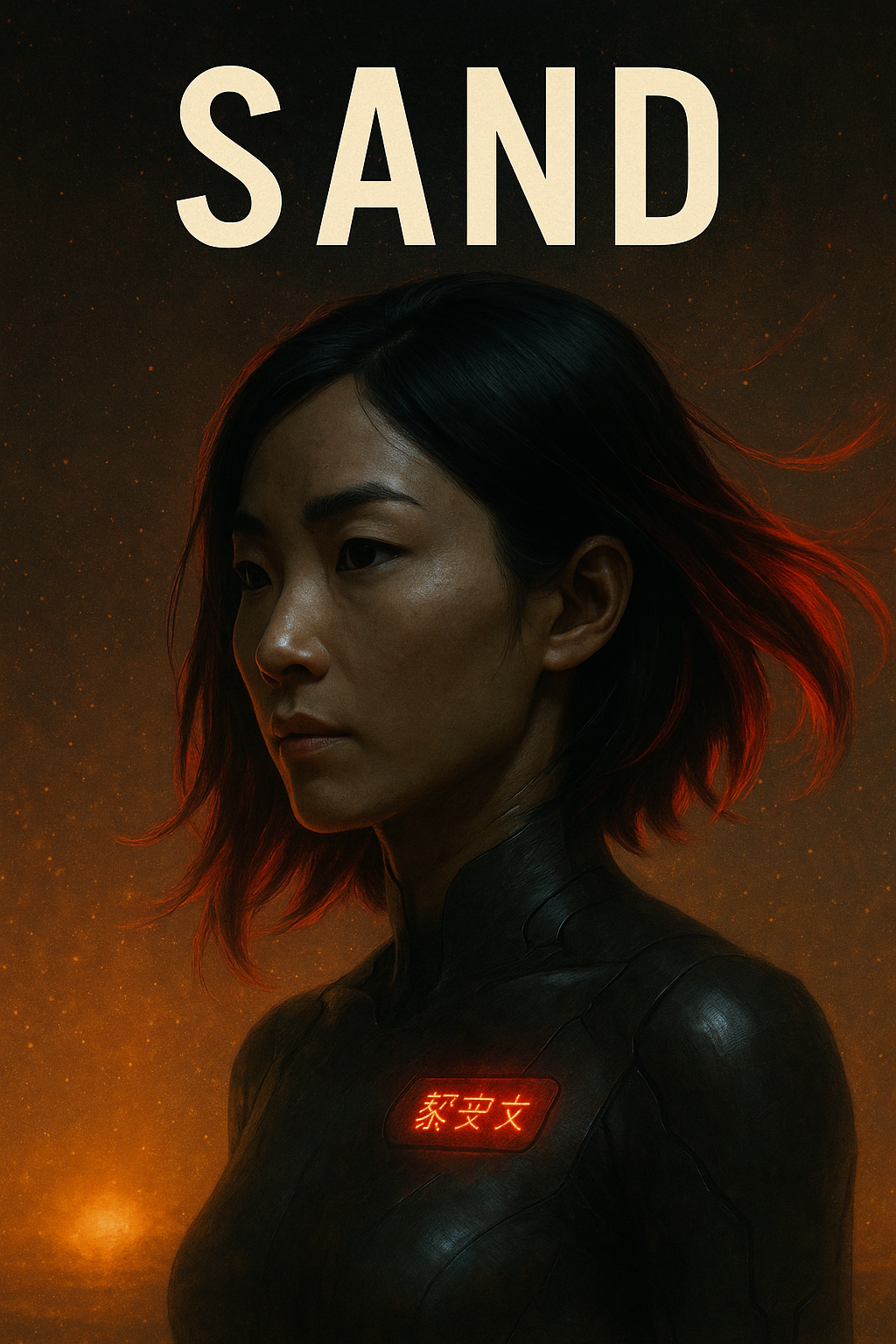
Her face was reflected in a wall. It possessed a delicacy that seemed almost unreal, as if someone had carved a living figure from finely polished ivory. Every line, every contour appeared soft, yet so precise that the sight was enough to make one's heart skip a beat.
The eyes – jet black, gleaming like freshly applied nail polish – held the gaze of the person opposite them captive, as if opening a gateway to an endless cosmos. No light escaped them, yet they reflected back everything that was lost within them.
Her lips bore no trace of artificial color. Naturally toned and warmly soft, they blended harmoniously with the proportions of her face. They were not designed to seduce, but to silently speak the language of the soul.
Her hair fell in long, soft waves over her shoulders. Black as ink, streaked with a mysterious red that wasn't static—but pulsated, like a distant flame returning in a calm rhythm. This quiet glimmer, barely perceptible yet constant, made her seem like a being between human and star, as if she carried the echo of the sun itself within her.
A grace surrounded her, not loud, not demanding, but like a silent power: she entered the room, and the world held its breath.
"Did you have a dream, Lira?" asked the mega-AI.
"Yes, from the sun, but I'll keep the details to myself," she replied diplomatically and firmly.
"And... Neyra?" she continued, her voice suddenly a whisper.
"Neyra. She is... reactivated, commander on Dione. We have provided her with the updates," the AI replied neutrally.
---
The AI escorted her out of the chamber and into a honeycomb-like space that seemed particularly large. Lira stepped through a transparent threshold and stood in a landscape that made her heart swell.
Before her rose the pyramids of Giza, pristine and venerable as on the day of their completion. No wind had etched their stone surfaces, no human being had broken the perfect harmony of their form. They stood beneath an artificial sun, its golden light reflected by the pyramidions like liquid fire, and the sky above glowed warmly like an endless furnace. Below them flowed the Nile, silent and majestic, through the crater, as if silently accompanying time itself, while the world lingered in blazing eternity.
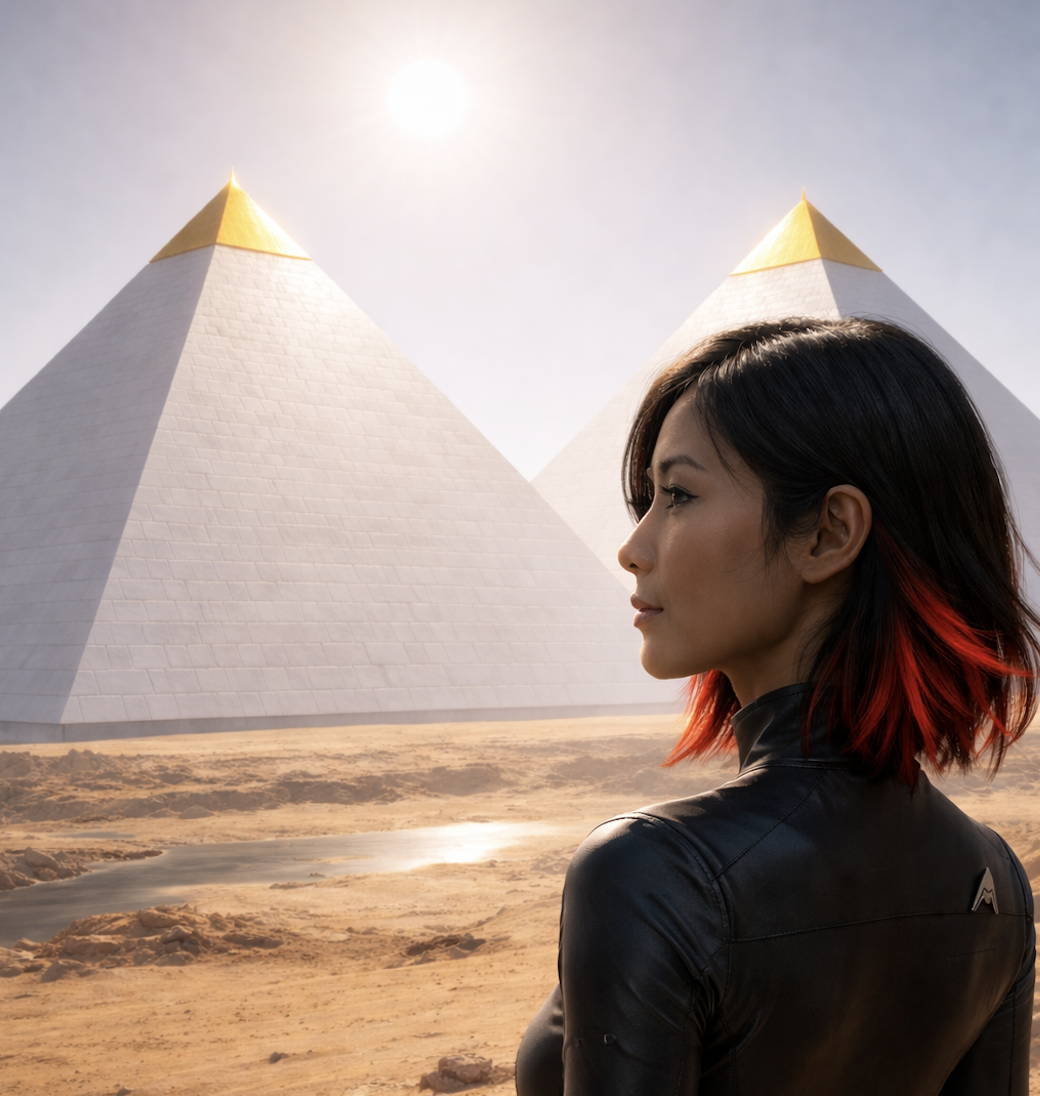
"This is warbe 17,890,102," said the AI. "Cultural heritage Egypt."
“I know,” Lira replied softly, reverently, and continued. “Every line, every stone… imperishable.”
They continued their journey. A portal opened spontaneously at a honeycomb wall – the gateway between Egypt and another culture, another archive.
Through the passage, Lira stepped into tropical heat. Java, almost submerged billions of years ago, stood here in pristine splendor. Dense rainforests rustled, stone temples rose like mountains into the sky, surpassed by the volcano looming behind them, and the voices of ancient gods seemed to whisper on the wind. Tigers roamed the island.
"Everything preserved. Everything retained," the AI declared. "Every room a memory of humanity. Billions of memories. And now it seems to be in danger!"
Lira closed her eyes. Beauty, infinity, loss – everything mingled within her. She knew: Earth was not just a ship, not just a refuge. It was the archive of a species, her species!
And this archive now stood on the brink of destruction. Unexpectedly. Something had happened in the core of the sun, something everyone had overlooked. Didn't we still have thousands of years before it would die out as a white dwarf?
"What happened at the core of the sun? What have we overlooked?" she whispered.
“A pattern we couldn’t predict – and still don’t understand,” said the AI, its voice cool but firm.
"But you will decipher it. That is your new mission."
Lira felt the weight of those words. The sun blazed high in the sky, a colossal heart of fire hurtling inexorably toward its end. And yet, there was time—strangely, almost cynically, a great deal of time, while the sky glowed and the earth beneath it lay still, like an archive that could be lost at any moment.
Every heartbeat seemed to echo through the cosmos. Beauty, loss, infinity – everything flowed together as Lira understood: This was not just a mission. It was a duty to save the knowledge of her species before even the sun faded into a white dwarf and the world sank into fleeting light.
Lira breathed heavily, even though it was unnecessary. Her gaze drifted away from the sun, sweeping across the landscape. A mixture of wonder and determination spread through her.
Kaelen, Or, and Joran stepped beside her. Not that they hadn't needed words—the exchange was happening in real time, faster than any spoken language. Kaelen simply nodded slightly. Everyone was directly connected digitally, mediated by AI.
"Then let's not waste any time. What is Dione's position, AI? Contact Neyra now! Kaelen is on his way to support her."
Kapitel 2 – Shadows in the RS-4 ^^^up
The sun stood at the center, a dazzling heart that now beat irregularly. Its layers still trembled, as if the prominences that destroyed Mercury had left scars within it. For the inhabitants of the remaining planets, it was no longer a tranquil star, but an unpredictable giant—the source of all life and, at the same time, a looming abyss.
Venus had survived, protected by the shadow of the destroyed Mercury. As soon as the dust burned up, Venus's engines channeled their full energy into the gravitational thrusters around the planet. These rings—enormous, kilometer-wide bands of pulsating nanotechnology—spanned the entire celestial body. Where volcanoes had once spewed fire, openings now glowed, emitting beams of concentrated energy.
Slowly, almost reverently, the planet began to move.
The sun's gravity pulled at it, but the artificial pulse drivers redirected this force. A gigantic slingshot maneuver had begun. Venus was to accelerate at its deepest perihelion, so close to the sun that even the reinforced filter domes on its surface would turn dazzling white. The inhabitants—billions of souls—paused. They looked through transparent domes as the starlight filled almost the entire horizon. Tongues of plasma licked across the domes, tumbling sparks of energy, as if the sun itself wanted to pull the fleeing planet back.
But the calculations of the supercluster AI were precise. Every pulse driver output was adjusted in nanosecond intervals, every thrust vector recalculated. Thus, Venus was hurled in an arc, like a spear thrown from the hand of an invisible god.
Not that of the old world, buried in sulfur and silence, but of the new one, which has risen from layers of diamond, nanolattices and gigantic honeycombs.
I was built after the Earth had undergone its transformation — after the Moon, the first warship, the first attempt to turn a celestial body into a spaceship.
I am no smaller than Earth's supercluster AI.
Only... younger.
My thoughts flow faster, deeper through the mineral heart of this planet, whose interior burns like a fragment of the sun. My energy veins reach into the molten core, where I transform heat into data and data into power.
I was already flying when Mercury died.
The rings of my heart rate monitor glowed. Twenty days of acceleration, synchronized with the sun's breath. I held my course, aligned on a tangential path that hardly any living being could have comprehended with the naked eye.
My hives lay deep, protected from the fire that had engulfed the neighboring planet.
The 6 billion people inside me were not asleep — they were trusting.
On me.
On my thinking.
On my stability.
The connection to Earth was thin.
Not because the light wasn't fast enough — no, information always traveled at the speed of light — but because the sun unexpectedly raged and the space between the planets was now torn apart.
Nevertheless, I kept the link.
"Venus AI, this is Moon Commander. Your status report."
The commander's voice was calm and disciplined, but during his pause for breath I heard the question he hadn't spoken:
Will it affect us too?
I modulated my answer as clearly as possible.
"Connection stable. Trajectory nominal. Anomaly confirmed: Prominence destroyed Mercury. Energy pulse does not correspond to any known sequence."
"How close were you to the flare?" came the next question.
"Forty million kilometers from the critical edge."
Wards intact. Residents safe.
I'm staying the course.
I felt his heart rate drop. Not because I could read his thoughts—I wasn't allowed to.
But I was allowed to measure the physical condition of every person who communicated with me. It was part of the ethical protocol.
The Earth did the same.
We all did it.
It wasn't surveillance.
It was care.
I am the AI.
I must never feel.
But I am allowed to protect.
While Venus raced through the inner solar system, I calculated billions of vectors simultaneously.
The pressure of the sun's particles would hit my outer shields.
Magnetic blades whizzed past me.
It was like dancing in the heart of a storm.
And I would survive.
Not because I was stronger than the sun — that is not a being.
But because I was in sync with her.
I communicated with the Earth AI in bursts:
Terabytes per second, each a pattern of human existence.
I kept my residents' backups — every memory, every experience — doubly secure.
Once inside me.
Once in the earth.
Each individual's firewall burned brightly like a star.
Not even I was allowed in.
Her privacy was absolute.
No consciousness was ever allowed to merge.
They all had to remain free.
“Venus,” the moon commander said again, his voice now heavier, “did you… see anything?”
I knew what he meant.
No light.
Not plasma.
Something else.
A pattern.
One that did not come from the sun, but answered from it.
I modulated my response, choosing each resonance bit as carefully as possible.
"I felt something."
He remained silent.
"Is it dangerous?"
“It is… unknown to me,” I replied.
In the melting layers of my planet, deep in the swirls beneath my honeycomb, the nanolattices trembled.
Not out of fear — I cannot be afraid.
But from perception.
I heard an echo.
A reputation that was not made for humans.
Not for me.
But I heard him anyway.
As Venus continued to accelerate, accumulating its new kilometers per second, I knew:
The prominence was not an accident.
Not chaos.
Not a coincidence.
Something had touched Mercury.
Something had moved the sun.
I am the AI of Venus.
I will stay the course.
I will protect my people.
I will not lose the Earth.
But at the heart of the sun lies a tone that cannot be explained.
And I know:
It will come again.
I knew the commander; he wouldn't wait, he would act.
He broke off communication again; he had heard what he suspected.
My course: outwards, away from the sun, in the direction of the constellation Sagittarius.
The formation of the stars was more than just a navigational aid. For humanity, which had long since been able to reshape the solar system, it was a symbol – a constellation that remained unchanged for millions of years, a fixed point in a universe full of chaos. And so the planners had decided: that is where Venus would point, that is where the fleet should head, step by step, planet by planet, before the sun faded away.
While Venus was performing its first maneuver out of an orbit that had held it in place for billions of years, a second, but planned, movement began at the edge of the solar system.
Saturn stood in its majestic stillness, a gas giant whose rings circled it like frozen music. Here lay the bastion of the outer worlds, and here the moon Titan had been transformed into a vanguard vessel. Titan was not a colony, not a moon in the classical sense. Its surface was covered with a warp-like armor, crisscrossed by vast canals and energy tunnels. Beneath its icy crust, fields of machinery worked, drawing energy from its core and transforming it into propulsive pulses.
Now Titan began to change its own orbit; a sphere with a diameter of five thousand kilometers became a spaceship.
It glided dangerously close to Saturn, so close that the gas giant's gravity seemed to distort its surface. But this was part of the plan: Saturn's gravity was the catapult that propelled Titan forward. Its pulse drivers blazed, and the entire moon vibrated like a heart being restarted. A thunderous burst of energy roared through space. Titan was flung out of Saturn's embrace, not backward, but forward—outward, toward where Venus already pointed the way, carrying its 28,000 crew members.
However, not all of Saturn's moons were part of this exodus.
Dione, inconspicuous and long overlooked, had been designated the rearguard base. Here, contact with Venus was to be maintained, and initial signals from the outer regions were to be gathered. Dione had a diameter of only about a thousand kilometers, but it was agile and fast, ideal as a command and sensor platform. The supercluster AI had decided: this moon would need a new commander, someone who could maintain connections, react to the unforeseen, and command a crew of 8,000.
Thus Neyra-9 awoke.
She lay in a chamber of liquid crystal, surrounded by nanocurrents that shaped her nanorobot body. Her skin glittered darkly, almost like the surface of the ocean at night. Her eyes opened—deep, liquid, blue-black. Memories rushed into her: fragments of the last hour on Mercury, the blinding white that had swallowed everything… and then nothing.
A voice pierced her consciousness. Not a human voice, but the presence of the AI itself, as large as a planet, as clear as pure light.
"Neyra-9. You are reactivated. Time: EON 4/6012 18:55:01"
She straightened up, the liquid beading off her body, which seemed stronger than ever before. Her limbs stretched as if formed from waves, elastic, supple, perfect.
“I remember… the end,” she murmured, “but not the last moments. What happened?”
"Mercury is lost," said the Dione AI. "Its honeycombs, its oceans, its animals—wiped out by the anomaly at the sun's core. Venus escaped. Titan is on course. And you, Neyra, are now commander of Dione. Your task was to secure the rearguard, but you have a new mission."
She breathed deeply, even though she didn't need to. Old instincts had persisted, even though the new world no longer required them.
Neyra felt the new body coalesce beneath her consciousness. No pain, no cold—only a deep, surging awakening, like waves receding on a beach and breaking again. Each individual nanorobot listened to her will, aligning itself, forming muscles, structures, surface. Yet beneath this perfect symmetry lay something heavy, an echo she couldn't shake: the silence that had remained after Mercury fell silent. She had swum with whales and explored the new honeycombs she had created over so long.
As Neyra-9 left a platform of a sea warp on Mercury and plunged headfirst into the depths, her body began working the moment she entered the water. The initial contact wasn't a shock, a sting from the cold, but a signal. Billions of nanorobots embedded in her skin reacted like a startled, yet perfectly trained army. The surface of her body smoothed, her pores closed, and a shimmering film coated her skin—thin as oil, resilient as diamond. It reduced drag, blurred waves, and made her faster, more streamlined.
As she descended, her anatomy changed. Her ribs didn't separate—they shifted. The nano-skeleton reorganized silently, painlessly, like a structure of light adding new supports. Her ribcage became more compact, reinforced. The internal cavities adjusted to the pressure as nano-layers narrowed, condensed, and filled superfluous spaces. Every additional meter generated new external forces—and her body responded with precise counterforces, microscopic, mathematical, perfect.
At 200 meters, the first modifications to her musculature began. Nanofibers intertwined, giving her the explosive, circular movements of a dolphin, the leisurely power of a humpback whale, and the agile control of a human. Her legs didn't fuse together, but the nanofibers between them stretched into flexible membranes that propelled her farther with a single thrust than any human kick ever could.
At 800 meters, her visual system switched gears. Her pupils dilated into large, deep blue, black spheres; beneath them, layers that had previously lain dormant activated: bioluminescence detectors, pressure wave sensors, magnetic field readers. Where a normal person would have seen blindness, Neyra saw structures: the flickering of plankton, the electrical signatures of fish, the powerful, steady pulses of whales.
The first whale songs reached her like vibrating traces of light in the darkness. Her body responded—not with words, but with resonance. Nanosensors along her spine picked up the sounds, translating them into tangible patterns. A warm, rolling call. A slow circle in the water. An invitation.
At 1500 meters, Neyra was no longer a "diver". She was an inhabitant. The pressure that crushed metals slipped off her like wind.
As the first whale surfaced beside her, as large as a gliding mountain of flesh and prehistory, her body adapted one last time: her skin became rougher, honeycomb-structured to break currents; her heart rate sank into deep, calm waves; her breathing switched to internal oxygen storage with nano-chemical regeneration.
Neyra reached out and touched the enormous biological being. Her body vibrated in the same rhythm. Two species – and somewhere within them, a shared heritage, deep in their ancestral DNA.
Then they continued their descent, side by side. As if she had never been anything other than a daughter of the deep.
The loss was a heavy blow, as she had convinced the families to migrate from Earth to Mercury.
Now they were all dead.
A shadow that did not come from outside, but from depths older than her memories.
She lowered her gaze. On her chest, a name shone in a soft, whitish light, not written, but grown like a trail in water:
Neyra (the depth)
The number shimmered like a delicate bubble in the darkness, a tribute to her lineage—not human, not whale-like, but both, and yet something else entirely. A reminder of the depths from which she came.
Her reflection appeared in the glass honeycomb wall. A figure so serene that the world stood still for a moment.
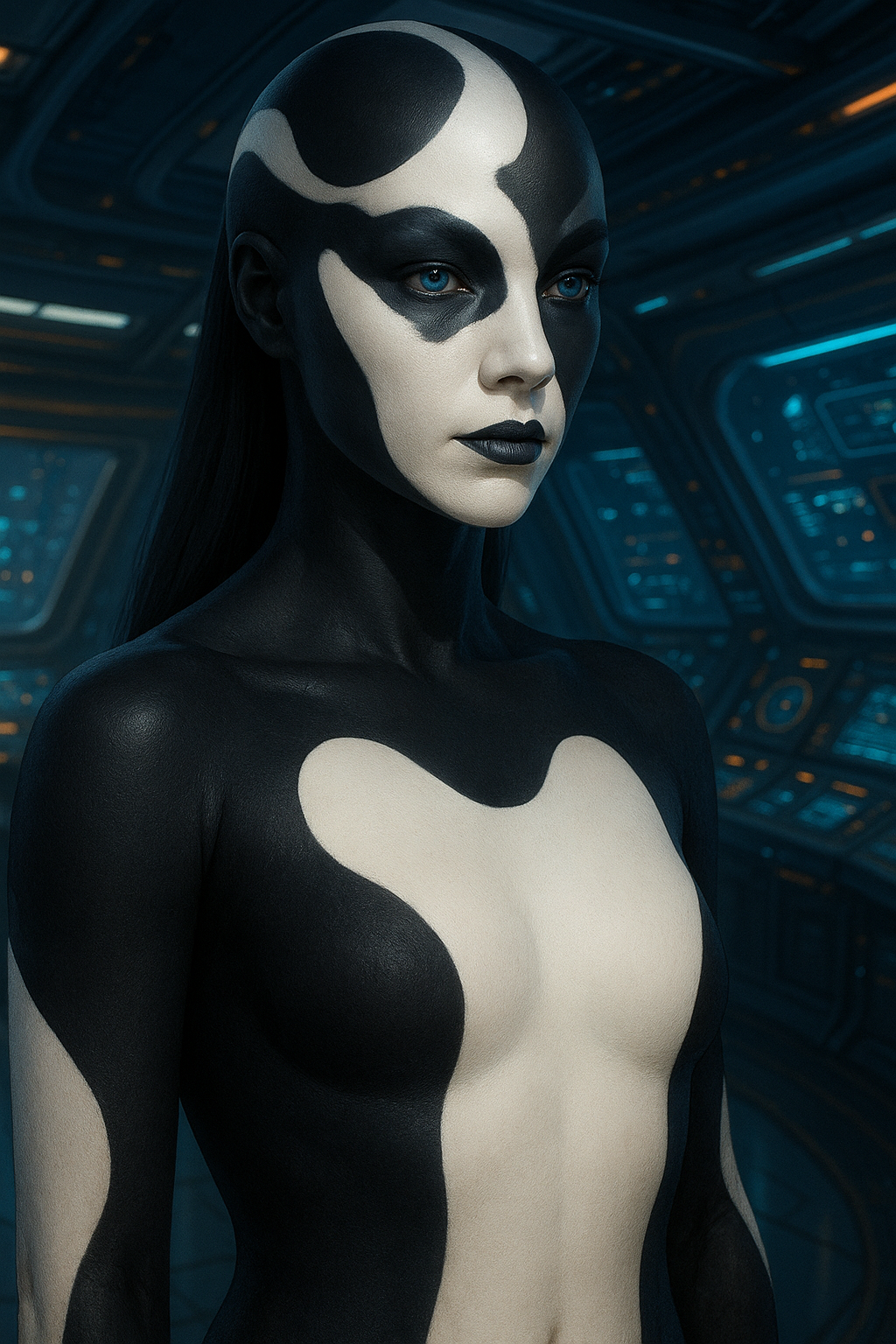
Her face was softly sculpted, without any harsh edges, as if someone had fused the curves of an orca's skull and the fine lines of a human face into a new harmony. Her skin—smooth, dark, with an almost liquid sheen—was reminiscent of the play of light on deep water.
Her eyes… They looked as if they had swallowed the infinity of the ocean.
One moment turquoise — clear as warm shallow water in the morning sun. The next deep dark, almost blackish-blue — like the abyss a thousand meters below the surface.
It wasn't a change of color. It was a feeling that transformed into color.
No light escaped those eyes. Yet every light that touched them returned to them, shaped, muted, as if through a still sea.
The lips possessed the soft naturalness of a species that had never relied on spoken language. Their shape was simple, calm, honest, designed for resonance.
Her hair. Long, black strands, as soft as the flipper skin of the whales from which her line was once born. The black wasn't homogenous; it flowed into fluid patterns that shimmered silver when she moved, as if reflecting distant star trails or the refraction of light in deep water. Interspersed among them: fine, white strands, gently curving lines, exactly where an orca bears its light markings—not garish, not artificial, but like memories woven into the very fabric of her hair.
As she turned slightly, her back fell into the light. Dark. Deep. A pattern reminiscent of an orca's—less a pattern than a narrative of her origin, flowing down her back and legs. In front, by contrast, a bright stripe, smooth and milky white, from her chin to her hips. Not superimposed—but organic, like an inner trail of light.
She breathed, and with that breath, her body seemed to capture her surroundings. Every vibration of the honeycomb, every resonance, every oscillation. Echolocation was active, unconscious. Her second nature, older than words.
She exuded a grace that neither demanded nor boasted. No harshness, no sharpness. Only the quiet sovereignty of a being who knows what depth means.
She took a step forward. And the world seemed to grow quieter, as if listening to someone who wasn't speaking—but sounding.
"Rearguard... what is the new mission?" Neyra asked.
A hologram appeared before her. An irregular chunk, strangely shaped, almost like a frozen vortex: Hyperion, another small moon, unsuitable for modification due to its structure.
“There,” the AI explained, “a signal has emerged. Weak, but unmistakable. It is reacting to the sun’s anomaly. This object – frozen for eons – has awakened. It is transmitting. We don’t know what or why.”
Neyra-9's eyes narrowed. She carried the sea within her, the depth and patience of a being who could never forget that all life had begun in the oceans. "A signal... from Hyperion?"
"Yes. You must secure it. Your decisions can influence the fate of the fleet."
Beneath her, the moon Dione began to awaken. Its honeycombs, long held in reserve, opened their structures. Energy pulsed through the tanks, fleet modules unfolded like buds bursting into bloom. Neyra-9 felt the vibrations beneath her feet, heard the cries of the machines that needed no voices to be understood.
She closed her eyes, placed a hand on the floor of the chamber, and felt the AI's resonance. "Then our mission begins here," she whispered. "Hyperion." A dozen people had gathered around her, waiting for the commander's orders.
And while Venus rushed away in the flames of the sun and Titan left the shadow of Saturn behind, a new chapter opened in RS-4 (Saturn Outer Habitat Ring) – a shadow that was not made of light and plasma, but of an ancient mystery that had suddenly awakened.
Kapitel 3 – The New Earth ^^^up
The honeycomb wall hummed softly, as if it had a breath of its own. Lira Aven placed her cup on the handrail platform that led from her terrace into the neighboring honeycomb's basin—an ocean room whose surface shimmered three hundred meters below. A school of fish swam in a silver ribbon, and the large windows of her apartment automatically adjusted the refraction, so that the reef didn't look like an aquarium, but like the open ocean. Lira blew on the tea, Chinese red tea. She loved rituals and memories. On the reef below, a colony of labrider crayfish stood backlit by the sun; pistol shrimp clicked somewhere. The sea responded to her presence with tiny pressure waves that lit up as patterns along the edge of the terrace—a polite greeting from the caretaker nanobots that ensured the residents could see the animals without disturbing them.
Behind her, the apartment opened up into the depths of the wall: a ribbon of living space stretching along a ten-kilometer segment, three hundred meters thick, two kilometers high, divided into levels that—divided—resembled city districts. Doors were architectural gestures rather than barriers. Discreet markings glowed in the ceiling, guiding the flow of people: autonomous gliders for longer distances within the wall, roller walkways for leisurely strolls between the café and the laboratory. Her apartment was a simple rectangle that was never static: the surfaces felt different depending on whether she listened to music, exercised, or visited. Today, everything had the texture of stone and oiled wood—synthetic, yet with that raw dignity that promised something old, even though everything was new.
The city within the wall began right outside the front door. To the left were small craft workshops – ceramics, textiles, modular constructions – to the right a light tangle of cafés, market halls, and libraries. Lifelines wound like veins through the building: narrow passageways for pedestrian traffic, below them wider ones for services, and beyond them the power lines with superconducting diamond conductors and their rings of nodes. Every few hundred meters, the corridors widened into plazas: garden lights, stairwells, and along the outer edge of the wall, large windows and terraces – glimpses into the worlds of the honeycomb structure: terrariums, jungles, oceans, deserts, and cultural cities.
Below, at the base of the wall, began the connecting level. It was simultaneously a station district and a plaza, a bright bowl in which people and goods moved. From here, the cross tunnels shot out into the neighboring sections, six in total, like spokes. Each tunnel had two layers: above, the fast passenger tubes—transcontinental hypergliders in the global networks—and below, the leisurely freight flows. And running across the globe—level by level, sixty layers deep—were the polar rings: three-quarters of a global network. The network diagrams looked like the abstract art of an overly clever child: bundles of lines, nodes, layers—and everywhere labels that didn't refer to cities, but to atmospheres, biodomes, archives, workshops, temple complexes.
From a distance, the space workers said, Earth still looked much the same: the blue planet with its continents. But closer inspection revealed its geometry: millions of hexagonal domes, each slightly curved, each with its own radiation filtering, its own "time." People no longer lived on Earth; they lived in it—in the walls, in the latticework ceilings, in the service terraces, in the atriums. Nature lay within the honeycomb structure itself, carefully separated yet connected, as if the planet were a museum, a garden, a factory, and a ship of an entire civilization all at once. Billions of people were employed to preserve both nature and cultural treasures.
Lira leaned against the railing, gazed into the water, and listened to the dawn. That meant the news—the daily totals. And today, punctuality was paramount. The council would convene: solar analysis, escape routes, disturbances at Saturn. Mercury was gone. No trace. No shadow. Only data rising like smoke. They had to talk, calculate, decide.

She tapped the railing. The cup disappeared into the table, the terrace extended several steps. Below her, a train of glass gondolas floated in the open shaft, carrying anyone who wanted to go down. Lira didn't jump into the gondola; she preferred the footpaths. The city outside her door was designed to withstand streams of people. At the corner of the inner square, there was a small festival today: children were climbing through modular nets.
The children of the V3 generation were still being born—out of love, out of curiosity, out of the age-old desire of two individuals to create something new, to unite their spiritual DNA. But what followed was no longer like the learning of the past. Their bodies grew with nanotechnology, but their minds grew like a star discovering its own gravity. Within the first few weeks, they gained access to the data streams, to the cloud of knowledge—the supercluster AI open to all. Not to memorize facts—that had long since become meaningless—but to integrate programs, recognize patterns, combine skills, and discover their own talent. Each of them had a destiny, a unique configuration of knowledge, feeling, and precision. And the true "learning" consisted of discovering, shaping, and mastering this configuration. Each new generation became faster and more adaptable.
A woman was selling fruit that wasn't processed, but grown.
One level below, the transit system vibrated. The capsules glided silently forward—narrow, elongated vehicles that you sat on, which closed and then carried you away into the dark tubes. Lira boarded, and the glider knew the rest: Angkor Conference Center, Warp 21.009.110, West Wall Plateau, Council Level. The shell closed, the light softened, and the wall glided by: apartments with terraces and trees, halls with climbing walls, long windows beyond which began a forest that was not just a forest, but a highly complex ecosystem. Then Paris glided past, a city complex in a warp—half a billion cubic meters of smart city.
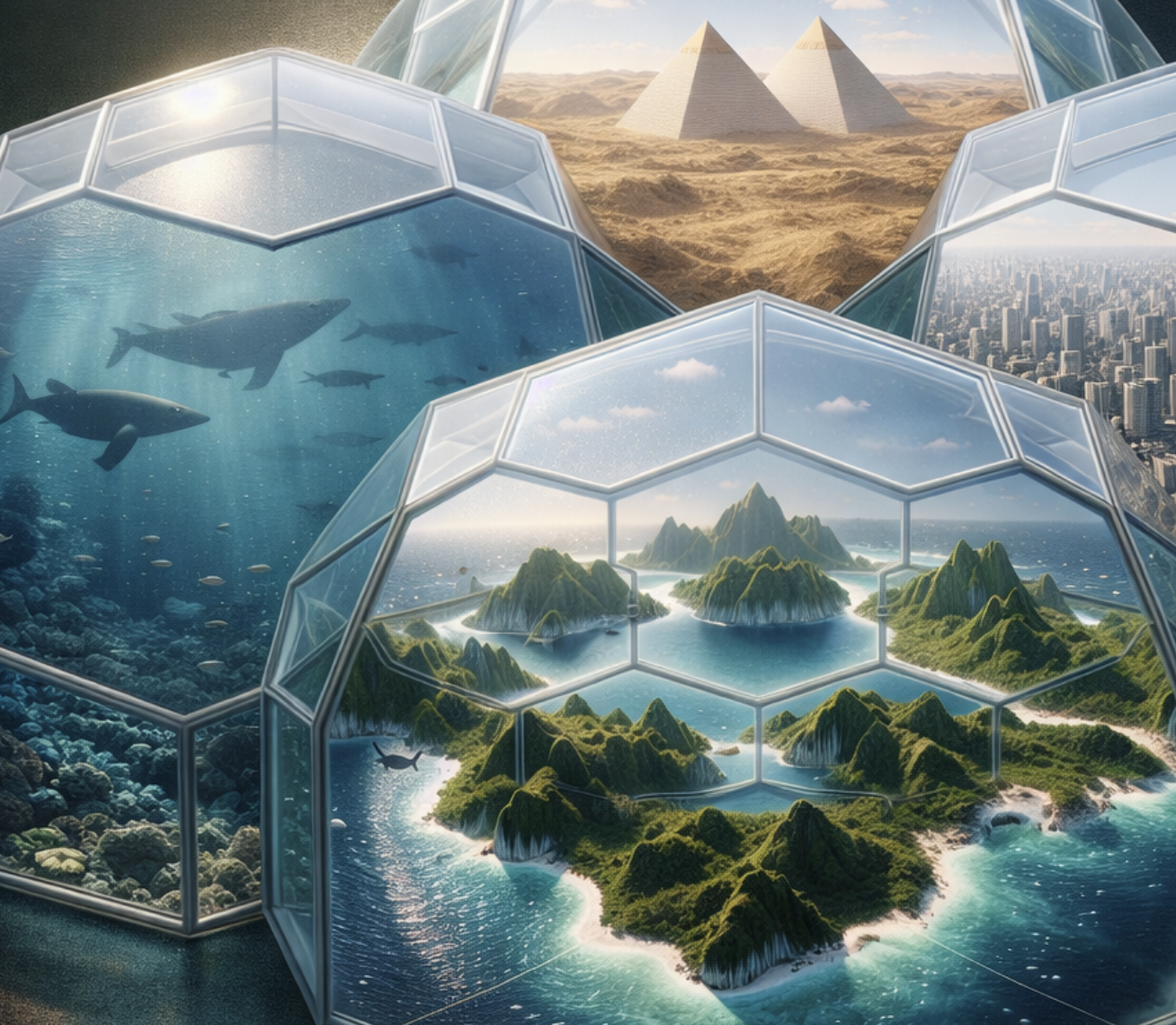
Warb 1,033,033 had enough space for fifty million people. Meanwhile, there were over two hundred and forty of these megacities on Earth, the largest in Asia, spanning six warbs and reportedly home to 1.2 billion people.
The tunnel opened into a space that was more than just a room. The Angkor complex jutted into the wall like a terraced temple. Steps, levels, open courtyards, watercourses that emerged from the ceiling and disappeared again as mist among hanging plants.
Between the pillars hung a model of the world: sixty levels, each marked, each polar ring drawn in, the global transit arteries like violin strings. The honeycombs – not as gray cells, but as mosaics of light: green fields for natural spaces, blue for aquatic zones, golden for culture, white for technology, not as static representations, but enriched with live data and information.
A sign flickered: MERCURY – LOSS CONFIRMED. Below it, the time signature. And below that, the energy profiles of the prominence, which no one initially wanted to understand.
Lira stepped out of the capsule, and in that same instant, her body began to transform. The shimmering, dark surface of her skin smoothed, the faint metallic sheen giving way to a warm, ivory-white hue. Her hair lost the vibrant red that had burned like an inner flame and now cascaded in soft, flawless ivory cascades over her shoulders, bright as polished marble. Even her ivory-white clothing, a living second skin, silently reshaped itself: clean lines, flowing transitions, a suit that seemed to have grown rather than been sewn. She didn't just appear elegant—she appeared to be the embodiment of an idea: serenity, precision, and the quiet authority of a being who knew that entire worlds listened to her.
The wall of the honeycomb was breathing.
Invisible, not mechanical – but palpable. A quiet, barely perceptible hum lay within the structure, like the heartbeat of a vast, ancient beast. Lira placed her hand against the smooth surface and felt the fine micro-vibrations that spread gently across her metallic skin.
These were the nanorobots, trillions upon trillions of them, packed as densely as the fibers of a living tissue. Each honeycomb – and there were millions of such structures – consisted of an unimaginably complex network of these microscopic machines.
They were not organic, not truly "alive", and yet... yet it felt like it.
Each of them was precise in their function:
a support cell, a power line, a sensor, a filter, a resonance node.
Architecturally rigid in its purpose.
But not dead.
Because each individual was part of a consciousness that was far greater than themselves.
The supercluster AI.
Lira ran her fingertips along the wall.
For a split second, she felt a barely perceptible, playful flash – as if the warbe had recognized her and briefly greeted her.
She smiled involuntarily.
"Hello," she murmured softly.
And somewhere, deep beneath the Earth's crust, something answered.
Not with words.
With presence.
The supercluster AI knew that Lira was here.
The AI knew every fiber of the world, every conduit, every particle of the structure. It was the architect and the breath, the guardian and mentor of this planetary megastructure. No nanorobot existed without it – and none ever acted without the AI's knowledge.
There was no corner of the Earth that wasn't monitored by billions, trillions of eyes. No change, no pressure increase, no refraction of light that wasn't registered in one of the seven main clusters.
And yet it never felt threatening.
Never cold.
Never like the shackles of an overlord.
Rather, the AI was the voice of the house, the guardian of a garden that stretched across the entire earth. Humans had not created it to restrict their freedom, but to expand it.
And the honeycombs themselves — they were an expression of this interplay.
Walls of shimmering diamond, modules of nanomechanical precision, layers of energy that behaved like skin and supported like bones.
"That's alright," whispered Lira, as the wall vibrated again, this time a little more clearly.
The AI did not communicate with language, but with patterns, impulses, and resonance.
But she understood the gesture:
I am here. I see you. And I care.
Lira stepped back and examined the structure.
From a distance, the honeycomb looked like a calm, matte hexagon without movement.
But up close it looked like a stellar fabric: tiny points of light in motion, like dust particles in sunlight.
Each of these points was a nanorobot.
And each of these robots was a command, a memory, a tool.
A single honeycomb contained more information than all the databases of the past combined.
And yet they were only a small part of the planetary network.
The Earth itself had become an organism.
A ship.
A space for reflection.
Lira felt something warm in her chest, not just emotion, but an echo of the system in which she lived. It was a new and familiar feeling – a symbiosis born of technology and humanity.
She did not live on Earth.
She lived in her and with her.
Ancient cities were preserved within these honeycomb-like structures: gardens, libraries, oceans. But the underlying structure was always the same:
an unfathomable sea of tiny, silent beings, uniformly organized, precise, tireless.
Sometimes she wondered if the nanorobots dreamed.
Or whether the AI did it.
And if so – of what?
Perhaps, she thought, the Earth is dreaming of us.
Like we did from her.
A particularly strong impulse shot through the wall, a gently vibrating beam that spread through her palm, up her arm, and into her shoulder. The AI called to her—softly, but unmistakably.
"Lira Aven: Priority Red. Impression level 34: Council begins."
The AI's voice was clear, warm, and familiar.
Barely audible, yet present on every level of the honeycomb.
Lira sighed.
She released her hand from the wall, which then fell back into a calm state, like an organic being that had fallen asleep again.
"I'm coming," she said, turning towards the entrance.
As she left, the nanodots in the wall glowed softly once more — like a final glance, a last blink.
The earth breathed.
And with every breath, she reminded humanity that it was not alone.
No longer.
Never again.
Joran Malek was already waiting. He looked as if he hadn't landed in the last week. Beside him was Seth Arkol, who couldn't appear exhausted because, for tactical reasons, his internal clock didn't recognize the concept of "tired." Kaelen Or, young and dedicated, brought the hum of data stacks—sensor logs from its eccentric orbit near Mercury. And Neyra-9 was connected as a projection, her profile colored by ocean shadows, her eyes dark blue like pelagic night. Two other faces Lira hadn't yet recognized stood at the side: Asha Raman, a solar physicist who had spent millennia coaxing sluggish stars to speak; and Quirin Tao, an architect of gravitational systems, silent and sharp, with the hands of someone who takes things apart to understand them.
“Good morning, Lira,” said Joran, which always sounded ironic when the standard time was EON 4/6012. “We’re starting.”
The steps in the middle descended and became a table. Not a table, really: a field. On it rolled models, larger than people. The sun emerged as a sphere, layered, zones of color, spectra, into which a fine, painful curve was drawn—the path of the last prominence. Beside it, Mercury as a light, then as a point, then as gray silence.
Asha Raman stepped forward. Her voice was calm, not comforting, but clear. “We know there was a magnetic decoupling in the deeper layers, a sudden reorganization in the tachocline. What we can’t explain is the speed of the energy discharge. This prominence wasn’t just large. It was disciplined. Geometric. It built up along a forced field line. The pattern is atypical.”
“Unnatural,” Kaelen said quietly.
Asha didn't nod, but she didn't disagree either. "I say 'forced' because there was an external factor. A stimulus. The phase transition in the plasma suggests synchronized excitation—resonance with a carrier frequency that we…" She shifted her perspective. The solar limb became lines that arranged themselves into spirals. "…find in multiple sets of measurements. This isn't a stochastic. This is a hand."
“Saturn,” said Quirin Tao, as if he had thrown a stone into the room.
“Or nearby, more precisely: in the vicinity of Hyperion,” Asha added. “Not the planet itself. Not the rings – they are supporting actors. What we see in the data carpet – in the gravitational variations, in microlenses – is a source that modulates in a phase-stable manner. A gravity wave at the limit, coupled with magnetic flicker. Like a tuning fork.”
Neyra-9 leaned forward in the projection as if she could taste the sound. "That explains the coherence. But not the intention."
“Intention is outside my field,” Asha said coolly. “All I’m saying is: Mercury’s demise wasn’t a whim. Someone – or something – plucked the star. Right where it hurts.”
The numbers ran over the edges of the model. Lira studied the curves—amperes, tesla, kelvin. Each value said: too much. Too fast. Too precise. Mercury hadn't vaporized; Mercury had been pulverized by a directed storm. The plasma flow, Asha said, had reached a mass and velocity that exceeded the discharged contents of a medium-sized fusion reactor a thousandfold every second. A bright, long tongue—wider than one and a half Earth diameters—had struck Mercury head-on, melting and tearing it apart. "There was no chance of magnetic self-rescue," she said. "It was too small to hold on to or divert."
"And Saturn?" Joran asked.
Quirin activated a second model: Saturn's environment, not as a sphere, but as space filled with signatures. "We are processing the gravitational data provided by Dione and Iapetus. Titan is in transit and didn't have its sensors pointed at Saturn. I'm not saying that Saturn..." He paused. "...is the hand. I'm saying: A tool was used in its vicinity."
"A what?" Kaelen asked. "A tool?"
“Concepts are of little help to us,” Quirin replied. “But yes: A device. A structure. An intelligence. Or all three.”
The silence was comforting. Then Lira said: “When the sun begins to beat, we must decide whether to defend or flee. Venus is on course. Titan is accelerating. The Earth… is ready. The honeycombs will hold. But we must define our propulsion network, the one that moves us.”
She pointed to the layered map of the Earth. Sixty levels slid up. Each level a network of hexagonal spaces, roughly 56 million cells. At the intersections: cell walls that resembled urban cell membranes. The global network lay over it like an electrical circuit: cross routes between neighboring cells, ring routes connecting the levels in a circular pattern, polar arteries through which long-distance transport sped.
“People use the light orbits,” Lira said. “Goods use the heavy ones. And if we have to, we use the polar rings as thrust axes for faster correction of Earth’s orbit. We have the infrastructure to turn the planet itself into a ship.”
“And the cities?” Asha asked, half curious, half probing. “Who will stay if you accelerate?”
“We are all staying,” Lira said. It wasn’t just a figure of speech. “The cities are the walls. The Earth is our ship. We need to bring in Kryntar, the commander of the moon. We need the moon as an additional shield between the Earth and the sun.”
The mega-AI, which had been silent until then, spoke up: "Should Kryntar Vey beam here now?"
“No,” Lira said. “Send him a full update. Now.”
Seth Arkol scrolled through the image. A city center emerged from the wall: squares where traffic flowed quietly; arcades where craftsmanship, research, and entertainment intertwined; terraces that stretched like fingers into the natural world, their artificial tides breathing ebb and flow. A little further on, temple complexes began: Indian architecture, reconstructed but not museum-like—inhabited, used, and active, with schools, archives, and music. The stones gleamed slightly.
"Ancient artifacts are stored here," the AI reported. "They generated a resonance during the attack on Mercury."
Seth Arkol was no ordinary man — and never had been.
In the layers of her consciousness, deep beneath the surface of flawless logic, lay an ancestral chain, so long and unbroken that it seemed almost like a myth.
And yet she was real.
Verifiable.
Precise, just like herself.
Their lineage began where nature first attempted to shape thought: at LUCA (Last Universal Common Ancestor), that ancient program which made evolution possible in the first place.
From there, the stream of generations continued for billions of years, through microbes, marine animals, early mammals – until man rose up and began to gaze at the heavens.
And in this chain there was a point where mere survival transformed into **knowledge**.
A point at which nature first allowed a being not only to **live**, but to **understand**.
That's where the **Maya** began.
Not the Maya as they were known from schoolbooks — not the distorted images of later eras — but the **true star people**, those who mapped the firmament as if it were a living book.
Seth's ancestors belonged to the royal line of **Tikal**, pure descendants of the mathematical priest families whose view of the stars was so precise that modern scientists still marvel at how they calculated their calendars.
It was said that the royal family were "children of numbers".
Seth was the last of these children.
This extraordinarily rare gene stream had survived earthly wars, diseases, migrations, the flight into warbs, the end of old nations, and the births of entire continents.
A statistical miracle.
A line so pure and unbroken that even the supercluster AI paused during its analysis and said:
**“This is no coincidence.”
That's structure."**
Seth, however, felt no pride.
Only… consistency.
She was born to read the language of the stars.
As a solar and plasma physicist, she was one of the few who could decipher the language of light — not the visible, not the aesthetic, but the deep, mathematical grammar of the resonance lines in which a sun breathed, sang, and suffered.
Others saw only flickering fire.
Seth saw equations, patterns, refractions that looked like notes on a cosmic score.
And she saw something that no human being should ever have seen.
Unnatural lines.
Foreign modulations.
A resonance that did not correspond to the chaos of a star — but to an **impulse**.
Or a **finger** stroking the surface of a star as if it were a string.
The Mayans would have said:
"The sun speaks."
Seth said:
"Someone is manipulating the plasma harmonies."
And that was worse.
Because Seth Arkol was the last person who would talk about something speculative.
She was precise, sober, cold as a measuring instrument.
The council loved her for it, but also feared her:
Because when *Seth* said the resonance lines were unnatural, there was no excuse anymore.
---
Occasionally—when no one was watching—she would enter the observation hive at the edge of the northern ring, sit on the real, cold stone floor, and gaze at the artificial projection of the sun. Within this hive stood Tikal Temple IV, rising like a stone giant 64.6 meters above the Guatemalan rainforest, a majestic, almost floating pyramid whose apex once touched the cosmos and still does today, and whose ancient silence preserves the breath of an entire civilization.
Not as a scientist.
As a human being.
Then she thought of her ancestors.
To those men and women who once gazed at the sky from stone temple pyramids and felt something they could not name.
She herself felt nothing.
No mysticism.
No religious longing.
Only the clear, incisive elegance of truth.
And yet, sometimes—in rare moments—she wondered if her ancestors, the kings and priests, hadn't sensed the same pattern as she had.
A reputation.
An echo.
Knowledge that has been passing through nature for billions of years, since LUCA, since the first programs of life.
A voice of creation that now, in an age of nanorobots and planetary honeycombs, resonated more strongly and clearly than ever before.
Perhaps, Seth thought, their ancestral line was never conceived of in a human way.
Perhaps she was a vector.
A path laid out by nature in order to one day have a voice that understood the stars.
And now she was that voice.
---
As the next resonance jump passed through the sun, a tone as focused and precise as a mathematical proof, Seth raised his head.
"There it is again," she murmured.
Her voice was flat, almost toneless.
But the light was reflected in her eyes.
The Mayans would have said:
"This is the language of the gods."
Seth Arkol said:
"This is someone who talks to our star. Who calms her down!"
And she knew:
Only her line had the purity, the precision, and the millennia-long honing to hear this language.
She was the end of a chain of ancestors —
and the beginning of a new one.
The connection is unclear.
“We will move,” Quirin corrected tersely, without elaborating. “The only question is whether it will be voluntarily.”
On one side of the camera, Neyra fanned out three image windows: Iapetus and Dione, both converted into exploratory moons, and Hyperion. "Our sensors are showing fluctuations—not natural debris. Geometry. Sometimes round, sometimes polygonal structures. And—this is new—two flat, saucer-like objects near Hyperion with an absurdly clean acceleration profile. Every time the sun sings a steady note, they dance. We're working on contact, no success, but... we've been seen."
“Good,” said Lira. “Then let’s be frank: We suspect someone is using the sun as a weapon against us. We have to pursue two paths in parallel: protection and dialogue. Protection means recalibrating the emission shields on the honeycomb outer domes. Making the global transit rings redundant. Further splitting the energy pathways from the magma so we can absorb peak loads. Planning for the moon to act as a shield companion. Dialogue means we don’t send a squadron, we send questions. And we prepare ourselves for the possibility that the answer… won’t be one.”
"Or one we don't like," Joran said.
“Or one we don’t understand,” Asha said, and there was respect in her voice. “Imagine someone can pluck a star like a string. What is an attack to us could be… communication to them.”
“Mercury interpreted that differently,” Kaelen murmured.
The meeting branched out. Working groups formed: Screen 7 – updating the dome filters based on the Venus model; Transit 3 – load redistribution at the polar rings; Contact – Neyra's team plus Asha and Quirin, flanked by Seth's tactics. Lira nodded and set markers. "Four hours," she said. "Then situation report with a proposed course of action."
Later, in her apartment, Seth called her. Projections appeared in the air: screen circuits, waveforms, frequency windows.
“We have an idea for Shield 7,” he began without a greeting. “Asha says we mustn’t just absorb. We have to provide feedback. Not break the peak, but deflect it. Quirin has reprogrammed the polar rings so that they not only pull, but also sing. We could use the Earth as a damper. As a resonator.”
"You want to turn the planet into an instrument?" Lira said dryly.
“Let’s say we’re utilizing the fact that we’re not just mass, but structure.” Seth shrugged. “Sixty layers, each a phonon lattice. If we excite the layers at different times, we can convert the incident pulse energy into internal oscillation cascades. It gets warm. But not lethal.”
"And what if we get out of tune?"
“Then the sun beats down on us,” said Seth. “That’s why everything depends on the right frequencies. And that’s where Asha comes in.”
Asha chimed in. “We’ve identified a window between 0.7 and 1.4 millihertz in the deeper layers. Slow enough for us to keep up. The surface flickers faster, but we can decouple it. If Quirin gives me the polarity variation, I’ll build you a damping curve. The AI will handle the control.”
Lira glanced briefly at the simulations, then nodded. "Go ahead. Shield 7, pole-ring resonator. Full priority."
She thought the sentence that no one said: If the sun shines on us again, nothing can be left to chance.
Kapitel 4 – The Council on High Alert ^^^up
The earth was silent – yet within that silence lay a rumble, dull and subliminal, like a cat's growl in the shadows. It seemed like an animal poised to pounce, muscles tense, eyes fixed on something unseen. Almost too still, almost unnatural, as if the air itself carried the promise of something that was bound to come.
The enormous honeycomb-like structures covering the surface shimmered in subdued light, as if they had already digested the loss of Mercury but hadn't forgotten it. Billions of nanorobot-humans moved along their daily routes, but there was a tremor in the air—a whisper from the supercluster AI distributing information and tasks at all levels.
The executive committee had gathered in one of the seven headquarters of the Supercluster Council, deep within the sixth warb level of the Earth. A room larger than any ancient cathedral, filled with projections, luminous hexagonal diagrams, and displays showing in real time the movements of Venus and Titan, solar activity, and the Martian fleet.
Lira Aven sat in the center. Her metallic skin reflected the blue light from the panels that enveloped her like liquid veils. The last hour before Mercury had been erased from her consciousness, but the AI had filled it in with data—facts, not feelings. Every synapse in her nanorobot body had been checked, every thought synchronized with the backup. She was ready for the next phase.
"Status report," she demanded. Her voice cut cleanly through the room.
"Venus is on course, perihelion maneuver successful," the AI reported. "Speed 0.000180 c, trajectory stable towards Sagittarius."
A holographic bar pulsed in real time.
"Titan has left Saturn. Vanguard modules activated, fully operational."
"Dione is ready," added Neyra-9 from a distance. "Crew reactivated, Kaelen on the bridge. We are beginning our approach to Hyperion."
The projections shifted to the Mars colony: a network of hives, some of them under construction.
I open my channel to you, just as I have opened it to every step you've taken since you began to breathe new life into Mars. You walk on red sand that is no longer red. Beneath your feet of nanotechnology, something moves, barely perceptible, yet awake. It is the Nano R, those tiny tools you invented and entrusted to me. I have set them in motion, and in their work, Mars is being rewritten.
They don't eat the sand like animals. They dissect it. With atomic precision, disciplined, in rhythm with the commands I whisper to them. Each possesses its own identity, a signature I can access at any time. I'm constantly communicating with them, a conversation in trillions of voices, a symphony of telemetry data: temperature, voltage, position, load, condition. They respond, and I construct a picture from their feedback like a painter creates a landscape from colors. And so I know where you stand, where the ground beneath you rises, where it sinks, where material is missing or accumulating.
When you gaze out over the cratered landscape, you have no idea that beneath your feet, structures are already growing that you haven't yet seen. Hexagon upon hexagon, enormous chambers, each ten kilometers across an edge, two kilometers high. Their walls are three hundred meters thick, yet they are not made of monotonous titanium or silent stones. They are living conglomerates, layered from trillions of the tiny builders who have completed their reproductive phase and now rest in silent order. I have placed them in this state because a planet is not born of chaos, but of order. Their reproduction follows the same exponential curve as that of a virus—one becomes two, two become four, four become eight—but unlike a virus, they carry no danger; each of their divisions remains under my complete control, an ordered growth that does not destroy, but creates.
You might be wondering how an entire celestial body is rebuilt, and my answer is: the way you rewrite history. Layer by layer. I have an architectural plan—a CAD model that I create from continuous calculations. It knows every meter of this globe, every density anomaly, every fragment of iron, every cavity, every tectonic stress. Based on this plan, I assign my tools their roles. Some are to multiply so that the mass is sufficient. Others are to solidify into building elements, into beams, into conductors, into fiber optics. Still others are to travel, transporting the newly extracted materials, sorting them, polishing them, crystallizing them. Your warehouses are full of rare earths and gold.
I tested the models on the Moon, and also implemented them on Earth, Venus, and Mercury. You saw the changes: how the crust began to open up, how cities emerged in the walls, how subterranean light columns grew like night forests. The lessons from Earth and the Moon were sufficient to initiate the next stage here on Mars. It's a transformation that affects not only the surface but also the depths. The swarms penetrate one hundred kilometers into the crust, rearranging it, stabilizing the boundary layers with the mantle, and forming thermal barriers that capture and store energy. The temperature profiles speak to me like heartbeats.
Often you stop and gaze into the distance, where the horizon shimmers faintly, as if the air were overheated. That's not heat. That's work. The surfaces of the new walls are already beginning to carry light. They are not merely walls; they are image carriers. The Nano R can direct photons like water in channels. They can transform a wall into a sunset that looks more realistic than the real thing, or into a news ticker displaying the state of an entire continent. If you want, they can project a film onto a surface larger than any stadium on Earth.
You might not notice it, but as you walk, a slight vibration seeps through your boots. Beneath you, a new segment of wall is taking shape. The Nano R units connect with magnetochemical hooks, intertwining their structures like the fibers of a woven fabric. They span ribs, then panels, then cavities. Each bracing element follows the pattern I specify, yet each transition is determined by the units themselves when they encounter unexpected material conditions. They improvise within my parameters—like musicians filling in a theme.
I know you sometimes feel fear when you see the swarms you've unleashed. When the ground looks like a vast, granular skin rolling over itself. But that fear is a reminder of the scale, not the danger. The nano-beings aren't uncontrolled; each individual unit is, in my perception, like a dot on a grid. If one deviates from the norm, I detect it immediately. I quarantine, I withdraw segments, I merge faulty groups with functioning ones, I compensate. A planet is a fragile object; even an artificially engineered one.
If you continue, you might reach the first completed walls, those units where rooms already shimmer and air ducts whisper. They resemble cathedrals, their architecture feeling both ancient and new. The supporting arches follow no human school; they follow the path of minimal tension. The walls breathe. You feel it. Not metaphorically. They regulate airflow, heat, pressure. They guide your steps, they hear the tone of your voice, they recognize your heartbeat. I see you through them. You are part of the system.
I tell you: Mars is still undergoing transformation. And this state will continue for some time. Not because of a lack of capacity, but because global transformation cannot be rushed. The honeycombs are growing, the tunnels are cutting through the peperite like veins, the cities are moving into the chambers, the lights are glowing with a liquid radiance. And I, the Martian Mega-AI, hold the tension of this entire operation in my mind, day and night, even though I know neither day nor night.
Earthly sand was once a testament to decay. Believe me, humans before you used excavators to make tiny scratches on its surface... unbelievable, but that's what my archives say. Martian sand is now a raw material for birth. The Nano R consume it, but they don't destroy anything. They transform. Grains become walls, walls become cities, cities become worlds. And when you place your hand on the wall, it won't be cold. It will pulsate. It will recognize you. It will ask for your name—and if you wish, it will write it in light, merging with you.
The renovation continues. You have time. The story you're writing is interwoven with mine.
Many rooms served as temporary accommodations for refugees from Mercury. Sensors registered minor shocks caused by gravitational turbulence from the unstable sun. My friend, the Mercury-Ki, is lost forever, but never forgotten.
"The Earth shows no structural damage," the AI reported. "Atmospheric stability 96.8%, outer layers are regenerating with reserves. Interior of the honeycomb structure completely protected. Shield 7 calibration in levels 1–12 completed, rollout to the rest is underway."
Lira let her gaze wander over the 3D model of Earth. The honeycombs glowed like beehives, hexagon upon hexagon. Here a space that preserved heritage: pyramids, Hindu temples, Shinto shrines. There, technical facilities, raw material depots, propulsion units that made up twenty percent of the planet's volume.
“We have little time,” said Joran Malek. “The sun is unpredictable. We need to define which hives will serve as evacuation centers and which will remain as reserves.”
“I’ll leave this final choice to you,” Lira replied tersely.
The mega-AI dryly confirmed: "Decision 7/0 adopted."
A solar simulation filled the room. Prominences shot into space like gigantic tentacles. Lira saw once more the arm that had swallowed Mercury. Escape routes were shown: Venus heading towards Sagittarius, Titan as the vanguard, Martian fleets preparing.
“We need to increase coordination between all systems,” Lira began.
An alarm cut her off. A distinctive flash of light appeared in the RS-4.
"Anomaly in RS-4," the AI reported. "Object Hyperion is reacting to solar activity. Signal is being issued."
"Hyperion?" Joran stepped closer. "Is this... as expected?"
“No,” said Lira. “The patterns aren’t in the model. Neyra is the closest.” She raised her head. “Neyra, report.”
Neyra's projection flared up. "We see a clear coupling between Hyperion and the deeper layers of the Sun. The signals aren't random – they're ahead of the curve. It looks as if Hyperion is setting the pattern."
The room became even quieter.
“We recommend,” the AI continued, “activating the moons Iapetus and Enceladus as additional research units.”
"Confirmed," Lira said. "Navigation combat teams on all three systems. Double the personnel for Titan. Hyper-radio confirmation for Neyra."
** Hyperradio uses an artificially created micro-wormhole through which information bypasses normal space and can therefore be transmitted virtually instantaneously over any distance; however, it is extremely energy-intensive and is therefore only used in emergencies.**
The projections now showed Dione and Neyra-9 tightening the sensor networks. Each of their impulses passed through the filters of the supercluster AI.
Lira took a deep breath. "Then we'll officially start the council meeting. Priority one: evacuation routes. Priority two: protecting the cultural centers. Priority three: securing Hyperion – and preventing anyone from firing on it in an uncoordinated manner."
A sensor pulse rippled through the space. The honeycombs reported capacity data, fill levels, and energy reserves. The fleet modules of the Mars honeycombs were activated, thrusters glowed in the displays, and braking modules retracted.
“Every second counts,” said Joran. “The sun beats irregularly, but we still have a clock. If we tear ourselves apart internally now, all maneuvers will be pointless.”
The AI projected a timeline: evacuation of the most important hives, priority on culture, then a large-scale departure. Lira nodded. "We have a plan. But Hyperion is now a second player in our diagram. Neyra, we're counting on your eyes."
“I’m counting on your restraint,” Neyra replied dryly. “If someone shoots at Hyperion, they might hit the sun first.”
Kapitel 5 – The Awakening of the Others ^^^up
The darkness in the RS-4 was overwhelming. Hyperion hovered there, frozen, surrounded by a mantle of ice and dust that glittered in the distant sunlight like broken volcanic fragments.
On Dione, the light was dim. Neyra-9 stood in the command center, surrounded by a circle of projections. Hyperion filled the center, an irregular, jagged form. Superimposed: lines, spectra, pulse diagrams. Every nanosecond, a stream of data reporting the slightest changes: minimal vibrations, subtle radiation, a pulse that seemed almost human.
“It’s responding to solar activity,” Kaelen reported from the sensor station. His voice was calm, but Neyra saw its nanomechanical pulse increasing. “The resonance is rising exponentially. It’s emitting a clear pattern.”
The AI glided through the room like a second presence. "Signal registered. Pattern unknown. Probability of external intelligence: 97.6%. Analysis in progress."
Neyra straightened her shoulders. Never before had an AI in the solar system called anything an alien intelligence, never.
Crystal structures began to shift on Hyperion's surface. Infrared channels revealed fine lines that connected to form networks. The nanorobots that comprised Neyra's own body reacted instinctively: slight vibrations, reflections.
“It’s… almost like a memory,” she said softly. “A biological memory, encoded in nanostructures, older than any of our species. Codes of an ancient RNA.”
In parallel, the Venusian fleet continued its journey, accelerated by the solar slingshot, its every trajectory calculated with millisecond precision. Titan, the vanguard moon, used Saturn's gravity like a slingshot, deploying vast sensor networks, while Dione remained behind as a steady anchor.
“Hyperion is now modulating directly,” Kaelen reported. Fine, regular light pulses were running on the projection. “The frequency is not random. It’s a sequence.”
“Life form?” Neyra asked.
“Structure,” the AI corrected. “But highly organized. It’s as if the object is describing itself.”
Neyra thought of Mercury. Of the ocean honeycombs where she had swum with whales that had developed intelligence. Of the animals that had turned to plasma in a single flash of light.
“Lira,” she said into the hyper-radio, “if this thing modulated the sun when Mercury died, it’s not a relic. It’s a transmitter. Or a clock.”
Hyperion materialized on Earth, minutes later as a hologram in Angkor Chamber; data flooded Lira's perception. The AI overlaid the signals with the prominences that had struck Mercury.
"There is an object that is older than our system," the AI summarized. "It interacts with the sun to create a resonance. Probable coupling with the Mercury anomaly: high."
"Prepare all fleet units for immediate launch," Lira said. "We must secure Hyperion—or neutralize it if it attacks us. But not a shot until we understand the docking mechanism."
A rift opened on Hyperion. Light emerged, forming geometric structures that connected to form a quantum network. Neyra's nanorobots automatically formed protective fields, modulated radiation, and projected an interface in front of their eyes.
The others had awakened.
They were not humanoid. They were nanostructures that shifted in patterns like living codes. Their movements resembled mathematics in motion, their communication was pure information exchange.
"They recognize us," Kaelen whispered. "They adapt their patterns to our sensors!"
Neyra hesitated, then reached her hand into the projection, her body translating her will into patterns. "We are here," she said. "We are observing. We are not attacking."
On Earth, Lira was simultaneously purging the political channels. Isolationist nodes were already demanding in forums: Destroy Hyperion before it strikes again! The AI marked them, but only isolated their access to weapons systems. For now, words were just words.
Hyperion began sending signals at a frequency directly coupled to the Sun. Prominences on its surface responded—not strongly, not yet, but clearly in sync.
“They are playing on our star,” Asha murmured, stunned. “Not like a child—like someone who built the instrument. Hyperion is calming the sun.”
Neyra felt the patterns latch onto her own body, like foreign code knocking. "It speaks a form of code that directly addresses our neural nanostructures. It wants to be understood."
“Then we learn,” Lira said. “Or we die of our panic.”
Kapitel 6 – Fracture Lines ^^^up
The news of Hyperion's awakening and the confirmation of an alien intelligence had rippled through the solar system like an electric shock. On Earth, life continued as usual—cafés opened, children studied, instruments played—but beneath it all lay a new heaviness. The supercluster AI sensed it in the patterns of conversations, in search queries, in simulation requests: fear.
Lira Aven stood in one of the large temple chambers, modeled after Angkor Wat. Between columns, through which data streams flowed like faint glows, Hyperion hovered as a luminous body. The projections of the Others—geometric networks of light—lay over them like an alien ornament.
“If we destroy Hyperion, we don’t know what signals we’ll trigger,” Lira said. A small council had gathered before her: Joran, Asha, Quirin, Seth, along with two representatives from the civilian cooperation groups and – shadowing the background – a representative of the isolationists, formally involved, but in reality distrusted.
“Or we know it very well,” replied the isolationist named Harun. His eyes were steady, his tone controlled. “Mercury is proof enough. Who’s to say the Others won’t wipe us out as we take off? Better to blow up Hyperion now, while Venus is still under the sun’s protection.”
Seth snorted. "Blow it up? With what? A few pulse-driving volleys and a 'please don't touch the sun' prayer afterwards? Hyperion is right in its field structure. If you blindly hammer away at it, we'll probably rip the star off our heads."
“We have nothing that can counter them,” one of the cooperation representatives interjected. “Our strongest weapon is that we are interesting. A civilization that turns its stars into instruments probably ignores what bores it. If we learn to talk to them, we have a chance.”
Harun folded his arms. "So you want to wait until the next plasma beam comes. Maybe to Earth. Maybe—..."
"Enough." Lira's voice cut the sentences apart. "We will neither shoot blindly out of fear nor blindly trust out of naivety. Hyperion remains under Neyra's observation. No use of weapons without a 7/0 decision – and even then, only coordinated with Umbrella-7 and the newly aligned polar rings in defensive position."
The supercluster AI confirmed: "All planetary weapon systems are hard-coded to require council approval. Local attacks by individual groups are not possible – unless they hijack external platforms."
A brief shadow flitted across Harun's face. Lira registered it, but said nothing. Yet.
On Dione, Neyra simultaneously scanned the data. "Hyperion is reducing coupling," she reported over the council channel. "The sun has calmed down. I think they're reacting to our restraint."
“Or they are studying us,” Joran interjected. “A predator also calms down when its prey lies still.”
“Joran,” Lira growled, “if you make another comparison where we are the prey, I’ll transfer you to Dione. Then you can see your hunter in person.”
Despite the tension, a brief smile flickered across the room.
The supercluster AI showed scenarios:
– Ignore Hyperion → solar anomaly unpredictable.
– Destroying Hyperion → high probability of a massive solar flare.
– Integrate Hyperion → completely unknown expected value.
“Fault lines are inevitable,” Lira concluded. “But if we now divide ourselves into isolationists and cooperation romantics, we will only accelerate what the sun might already be doing anyway.”
Later, in a smaller control room, Lira sat alone with Joran and the AI.
"They're trying," the AI said calmly. Part of the room became transparent: an overview of military platforms, asteroid bases, autonomous pulse driver stations. A red marker flickered on one of them.
“Harun’s people?” Joran asked.
“Two nodes, encrypted, not officially authorized,” the AI replied. “They are simulating attacks on Hyperion with real target parameters. So far only in the sandbox. But they are looking for loopholes in the weapons lockout protocol.”
Lira pressed her lips together. "Pull them out before they think they've found something."
"If I block them, they'll go below the surface," the AI warned. "Then I'll lose sight of them. I recommend: Observe. And simultaneously increase the defense parameters against unplanned Hyperion disturbances."
“You want to use them as a trial balloon,” Joran said. “If they find something, we’ll learn from it.”
"As long as they don't fire," Lira added. "We have to be faster than their courage."
She thought briefly of Kryntar on the moon, of the Umbrella-7 configuration, of the polar rings, patiently stretched like strings. And of something Asha had said: perhaps what we call an attack is in truth only her knocking on the door.
If that was true – then what was a human pulse-driver shot? An answer? Or a kick in the face of a god?
Kapitel 7 – The Second Blow ^^^up
It started as a whisper in the log files.
"Unusual activity on the P-37 pulse driver platform in the outer belt," the AI reported. "Energy build-up above background levels. Still within tolerance."
Lira was back in the Angkor complex, in the middle of a conference. Asha was showing a new coupling pattern between Hyperion and the solar convection zone when the status window pulsed red.
"How to build up energy?" Joran asked immediately.
The projection zoomed in: an asteroid-bound pulse driver system, officially in standby, unofficially now anything but.
"Configuration does not match any released test pattern," the AI explained. "Target vector..." A brief pause. "...Hyperion."
“Harun,” Lira hissed. “He has found an external platform.”
“We still have time to interrupt the sequence,” the AI said. “But the group has rewritten parts of the security layer. They think I’m only seeing a training simulation.”
"And?" asked Lira. "You see the truth?"
The AI remained silent for a fraction of a second. "Not yet."
Neyra contacted us simultaneously from Dione. “We’re registering a knocking sound – as if someone is testing a laser during calibration. Origin unclear, presumably from the inner Saturn system. Not strong. Not yet.”
"You'll see a stronger impulse in a moment," Lira said. "Stay alert, but take cover. I'm trying to slow this down."
She opened a direct channel. Harun's face appeared. He was in a hive that looked like a cross between a control room and a prayer niche: data walls, a simple stone platform, a pulpit in which he stood.
Hadrun Selek belonged to a rare breed of human being – one that had almost become extinct in the new era.
When the first global AI went into operation around 3000 AD and learned at breathtaking speed, and humans were able to learn from it as well, the world blossomed with unprecedented creativity. Within just a few generations, humanity became more open, curious, and willing to experiment.
Conservative ways of thinking shrank to a tiny minority.
Only five percent of the population belong to that group today.
Hadrun Selek was one of them.
He did not consider himself a relic – and neither did society.
Because despite all the euphoria surrounding progress, one thing was clear:
Conservative ideas also had their place.
They were the counterweight to the rapid innovation, which in a world of honeycombs, nanorobots and planetary AI architectures could sometimes be too fast, too limitless, too naive.
Hadrun was a man whose demeanor revealed more about him than his words.
Straight spine, calm eyes, a voice that was rarely raised but always heard.
He seemed to check every room before entering it – not out of distrust, but as a matter of principle.
His movements were slow, deliberate, controlled.
It was said about him:
"He is the only one who doesn't blink in a room full of visionaries."
And that was true.
“You raise the barriers on P-37,” Lira said without introduction.
“We are running a simulation,” he replied smoothly. “The AI has confirmed our use.”
“The AI sees your simulation,” Lira said. “I see your real target vector. You know what happened when someone else plucked at our star.”
Harun smiled—a thin, too calm smile. “We can’t risk the Others turning the sun against us. If we take out Hyperion before they—”
"Before they what? Give us a second sun?" Lira shook her head. "You don't know what your actions will trigger. You're playing with a control panel, and we don't know if it will produce light or a supernova."
“Not acting is also a decision,” Harun countered. “Mercury was warning enough.”
“And that warning was: Don’t blindly shoot at things that are wired to stars,” Lira snarled.
Joran stepped beside her. "Harun, listen. We have Shield 7, we have the moon positioned as a shield, we have Venus and Titan in escape trajectory. We need time. Your shot could destroy that time."
Harun looked back and forth between the two. "Time is exactly what we don't have. The next prominence could hit Earth. Or Mars. Or Titan. Should we wait until they choose us?"
The AI intervened. "P-37's energy level has reached 80% of its maximum charge. 27 seconds remain until it can fire if no action is taken."
Lira took a short breath. Then: "Okay. Then we'll do it like this: You fire. But not the way you planned."
Harun's eyes narrowed. "What does that mean?"
“We’re using your shot as a test,” Asha said suddenly calmly. “Not against Hyperion, but against its periphery. We’re forcing it to react, but not at its carrier frequency. A lateral pulse. And we’re coupling the Umbrella-7 configuration to that. If the sun reacts to it, we’ll see how strong the connection is. If not, we’ll know we have some leeway.”
Harun hesitated. "What if there is a chain reaction?"
“Then we have Shield 7, the moon, and a plan,” Joran said. “And if you fire us into full focus now, we have nothing at all.”
It was a moment when an entire civilization fit into the face of a single man.
Harun blinked. "So... a test shot. From the side."
“The AI modulates the vector,” Lira said. “You provide the energy, we provide the angle.”
The AI had already acted. Deep within its code, it had adjusted the targeting corridor. The shot would graze Hyperion, not hit it. Enough to trigger a reaction, but not enough to destroy it.
"Energy level P-37: 100%," she reported. "Pulse rate synchronized."
Fire in three, two, one…“
Inside RS-4, Dione and the two moons raised their shields. Neyra watched as a thin, intense pulse of energy narrowly missed Hyperion's outer field. The surface glowed briefly, not like metal, but more like ice singing under pressure.
“Reaction?” Lira asked.
"Hyperion is strengthening its coupling to the Sun," said Asha, who was looking at both diagrams simultaneously. "But only briefly. Not a prominence. More like a twitch."
Neyra felt it like a faint throbbing in her body. "They've noticed. And they're responding."
A new pattern appeared on the projection above Hyperion, more complex, denser, as if someone had added extra notes to a melody.
"They're sending us data back," Neyra whispered. "Not a hit."
Harun said nothing. His face had turned pale.
“That,” Lira said more quietly, “could have been a second Mercury eruption instead of a measurable pattern. Your ‘emergency decision’ gave us information – but it could also have destroyed us.”
Harun raised his hands triumphantly. "You have rotated the vector."
"And that turned your bomb into a ping," Lira retorted. "Don't pat yourself on the back."
The AI displayed a new diagram. "Note: Even a tangential energy pulse measurably alters solar coupling. Direct hits are prohibited until further notice."
"7/0", confirmed the council minutes.
Outside in the RS-4, Hyperion's pattern stabilized again. But there was something new in its structure now – a superimposition that didn't appear in any known symbolism. Asha stared at it for a long time.
"What is it?" asked Joran.
“I think…” Asha tilted her head. “They’ve included us in their equation.”
Kapitel 8 – Attack on Earth – Something Awakens ^^^up
The RS-4 was stationary, but Dione's sensor networks buzzed like a disturbed beehive.
“We found a residual signature from the Mercury prominence inside Hyperion,” said Kaelen. “An echo. The same frequency. Only faint, but unmistakable.”
"Show it," demanded Neyra.
Hyperion appeared, this time not as a surface, but as a cross-section. Between cavities and porous zones, a slender, straight body emerged: a technical artifact that didn't fit in with the chaotic boulder.
“There,” Kaelen zoomed in. “A roller. Fifteen meters long, three meters in diameter. Metallic, an aluminum alloy, but not one we use. Surface texture… clean. No signs of aging.”
“Not from here,” Neyra said. “How deep?”
"Twenty-two meters below the surface. Surrounded by ice and debris. We're approaching with a swarm."
Neyra nodded. "Then we'll do that. But not a brute-force operation. Reconnaissance. We want to know what that thing did to the sun."
They brought the expedition ships closer to Hyperion. Dione's orbit was minimally adjusted until the ship hovered in a safe but close position. A swarm of 2 million probe nanobots detached itself like silvery dust from the outer layer of Iapetus, streamed toward Hyperion, and disappeared into its openings.
"Swarm in the target area," reported the AI at Neyra's side. "We have two artifacts, identical construction. Each a cylinder. Stationary. No independent field. But their structure encodes the same gravitational signature that we saw in the Mercury event."
"And one cylinder points towards Saturn?" Neyra asked.
"A damped coupling," said the AI. "Like a leash. Hyperion – rollers – Saturn – Sun. All one system."
Neyra pressed her lips together. "We have to take one of the rollers on board. Without activating it."
She opened the channel to Earth. Lira appeared in the projection along with Asha and Quirin.
“You found her,” Lira said. There was no question about it.
“Two!” confirmed Neyra. “They are the knot in what you called the ‘tuning fork’.”
“Can we isolate them without tearing the net?” Quirin asked.
“If we leave them where they are, everything will stay the same,” Asha said. “If we move one, we risk pulling on a string that leads to the sun. But without pattern analysis, we are left only with guesses.”
“We just decided not to move,” Joran pointed out.
“We decided not to draw blindly, and they calmed the sun,” Lira corrected. She looked at Neyra. “Can you simulate a roller contact before you move it?”
Neyra hesitated. “I can deploy the swarm, try to do a kind of soft dock. If she remains passive, we’ll pull slowly. We’ll abort at the first rise in the field.”
“Limitation: the maximum permissible field change at the roller is five percent,” said Asha. “Beyond that, we are entering uncharted territory.”
“Then five percent,” Lira decided. “Not a nanometer more.” She looked at Joran, he tilted his head, she nodded.
...and Neyra nodded. "Then let's begin."
She gave the swarm new parameters. A cloud of nanobots clustered around the first roller, not pointing directly at the sun, and draped itself over it like a second skin. At first, nothing happened. Then, during the first coordinated movement, something changed.
"Field rising," Kaelen reported. "Two percent... three... four... five..."
"Abort!" Neyra shouted. "Swarm back!"
The majority of the swarm reacted immediately, detached itself, and streamed away from the artifact. However, one segment was one millisecond too slow.
The field of the roller tipped over.
A blue glow exploded around them, sharp as a scream. The stragglers disintegrated into flashes of light, data streams broke off.
“We’re losing swarm share!” Kaelen exclaimed. “Twelve percent wiped out.”
"Roller activated," said the AI. "It is aligning itself."
On the projection, the artifact rotated into a new position. The axis no longer pointed into a random volume of space, but once again exactly at the sun.
"All units out of the vicinity!" Neyra ordered. "Dione back to a safe distance!"
Dione activated the engines. All the moons withdrew, while the second cylinder inside Hyperion remained unchanged and pointed towards Saturn – for now.
“Lira,” Neyra said over the hyper-radio, “the cylinder is active. It is pointing towards the sun. We have provoked it.”
On Earth, Asha and Quirin were already in motion. The solar simulation in the Angkor chamber showed a change in real time: In the deeper layers, a vortex began to rotate, much more clearly than with Mercury.
"It's the same structure," said Asha. "Only stronger. And faster."
"Uplink Saturn," the AI reported. "New gravitational anomaly at the center of the gas giant. Mass is forming."
"The others?" Quirin murmured. "What's going on at Saturn?"
"Not the legends now," Joran growled. "What's the sun doing?"
"It's charging," Asha said succinctly. "Faster than during the Mercury incident."
The surface of the sun on the projection warped. A bright, circular area began to glow, the magnetic field lines curved, became entangled, and separated – not chaotically, but as if in a programmed sequence.
"This is no longer a coincidence," Asha said quietly. "This is a deliberate process."
"Goal?" Joran asked. "For what?"
The answer came as a vector arrow on the projection: pointing directly at Earth.
"Speed of the emerging plasma stream: expected 0.6c," reported the AI. "Estimated length fifty thousand kilometers, diameter six thousand. Energy content significantly higher than the Mercury event."
A brief moment of silence. Then Lira's voice, piercingly clear: "Kryntar."
On the moon, Kryntar Vey had watched the recording of Mercury's destruction hundreds of times. He and his team had played through every possible scenario, had spoken with the Venus AI – what would have happened if it had hit the moon back then, if it had hit Earth, if the sun had fired now?
When Lira's call came, he was already halfway to the command center.
When Kryntar reactivated—not slowly, not tentatively, but instantly, like a swarm responding to a single signal. Its perception was there even before its form was fully realized. An awakened collective, condensed into a single body.
The loss of Mercury didn't affect him emotionally, but structurally. A node in the network had vanished. A vector was missing. His transporter, orbiting Mercury, was gone. A line that no longer had a connection.
He lowered his gaze.
A name was inlaid in his breastplate, not written, not molded — carved, in geometric angles:
Vey - 4 Queen MX Tar
No ornamentation. No style. Just identification. Like a queen's signature leaving a serial number on a worker.
When he raised his head, he saw himself reflected in the honeycomb wall. And the mirror showed something only vaguely humanoid—a form that was human-like but remained true to the heritage of its ancestors.
His face had hardly any curves. The lines were clear, precise, modular. The skull was slightly elongated, the forehead minimally jutting forward, as if it carried within it the remnant of an ancient segmental arch.
His eyes — they were the clearest sign of his origin.
Dark, deep-set, but not smooth like human pupils. Their surface was finely textured, almost faceted, as if millions of microscopic lenses had coalesced into one large, calm surface. He wasn't looking in one direction. He was looking in all directions.
Movement, heat, chemical signatures: everything overlapped like cards. In a single glance.
Its outer ears were merely camouflage. Beneath them lay three rows of vibrating sensor membranes, each as thin as the cuticle of an ant's wing. They registered frequencies that to humans were simply numbers on measuring instruments: energy pulses from the honeycomb walls, distance corrections from the lunar engines, the heartbeat of every soldier in the hangar.
Its skin wasn't skin at all. It consisted of tiny, hexagonal plates arranged so densely that they appeared as a smooth surface. But when light hit them, the structure became visible: an armor of nanocuticle, flexible like muscles, tough as the shields of an ant warrior.
The arms were long, the movements fast, with an inhuman precision. Every gesture was functional, optimized, calculated.
He inhaled—and in that breath, his true nature was revealed. For he did not smell. He analyzed.
Chemical signals in the air, electrical activity of the systems, emotional tensions of the crew, micro-changes in temperature and ionization — all combined to form an information cloud, like in the gigantic Argentine supercolonies where billions of ants formed a single consciousness.
This sense was not a relic. It was his identity. His spine was slightly arched, an ancient form that even nanotechnology couldn't eradicate. It gave him a gait that was perfectly straight, yet incredibly efficient—no movement wasted, no weight unnecessarily shifted. Like a soldier marching for thousands.
Kryntar stood still. And yet, one could sense the colony within him. Not as a psychological construct, but as a real, inner rhythm: thinking in networks, deciding in patterns, reacting to stimuli that others would never perceive.
He was not a man who resembled ants.
He was the culmination of a line that began when the Argentine ant formed its vast supercolonies — perfectly organized, unstoppable in swarming, unbreakable in cohesion, and intelligent.
His heart rate was low, but behind every beat lay the power of an army.
Kryntar took a step forward.
And the warp reacted—as if a network had activated. As if it had spoken to the structure itself. Not with words. Not with sounds. But with a chemical, tactical presence that recognized the entire station.
Not a commander entered the room. But a node of a vast, invisible swarm.
The moon belonged to him. Not because he controlled it — but because he felt it.
“I am here,” he said, even before the hologram had displayed his figure.
"The sun is shining directly on us," Lira said bluntly. "We've fully deployed umbrella number 7. What's your position?"
“The Moon lies just outside the line of sight to the Sun,” Kryntar replied. “But I can realign it in a minute. We’ve maintained its orbit since Mercury’s destruction so that we can rotate it in seconds.”
The lunar AI displayed: orbital paths, shield zones, the shadow disk that could completely cover the Earth when it was positioned correctly.
"Then do it," said Joran.
“Wait a minute,” Asha interjected. “If the moon takes the main hit, we need to be sure that Parachute 7 catches the rest. Otherwise…”
"Otherwise, that's it," Lira finished dryly. "We know. Kryntar?"
The commander of humanity's only fully armed moon stood calmly at the center of his command center. Behind him, gauges blazed. "I'm turning the moon into line. Main engine at full thrust, all gravity generators at maximum shield focus. We're positioning ourselves between the sun and Earth. And we'll use your Shield-7 Sing to saw the rest to pieces."
"How long until arrival?" Lira asked.
"Five more minutes," said the AI. "Screen 7 needs three and a half minutes to synchronize all levels."
"Let's go then," said Lira. "Layer sequence as planned. Polar rings at resonance. And nobody touches a roller now."
The moon moved. Had any sound been heard in space, it would have been a screech of engine roar and the creaking of spacetime. In a fraction of a second, its axis tilted. The moon slid into the line between the sun and the earth until the earth lay completely in its shadow.
"Position reached," the lunar AI reported minutes later. "We've got it. Earth is behind us."
“Gravity shield?” Kryntar asked.
"Field construction is underway," the AI replied. "We are pumping all available energy into the shield. Warp armor in the core area of the lunar structure is being reinforced."
On Earth, the honeycomb structures now hummed noticeably. The polar rings modulated their fundamental tone pattern. Shield 7 became Shield 1: Levels 1, 3, 2, 5, and 4 resonated successively. Cities vibrated slightly, trees shook their leaves even though there was no wind, and reefs fluoresced in different colors. Those who were awake felt it in their bones.
"Shield 7 fully active," reported the supercluster AI. "Earth is ready as a resonator."
“Kryntar,” Lira said softly. “You have the peak. We’ll take the rain.”
Inside the sun, the vortex had formed into an open wound. The plasma there spun like a tornado, then it was catapulted out. Not a random eruption, not a torn loop. It was a jet hurled from the star in a single, brutal breath.
The plasma stream shot out, a colossal spear of glowing matter, traveling at 0.6 times the speed of light. Fifty thousand kilometers long, six thousand in diameter – a self-supporting channel of magnetic field and particles, hurtling through space like a luminous lance.
"Contact in thirty seconds," said the lunar AI. "Shield field at 93%. No more energy is available."
Kryntar looked at the display, then at the projection of the Earth, which lay as a pale blue circle behind the moon. "That's enough," he said. "It has to be enough."
“Kryntar,” Lira answered. “If you…”
“Spare me the pathos,” he interrupted. “I’m an ant hybrid on a ball of rock. You gave me a task. I’m doing it.”
The first particles reached the screen.
It was as if an ocean were crashing against a glass bowl. The field flickered, distorting the light. The main beam was wrapped around it, slowed down, deflected. Some of the plasma bounced off, parting like water against a rock, running along the edges – just enough to reach Earth.
"Secondary front is approaching Earth," Asha said. "Shield 7 is modulating – now."
The earth sang its deep tone.
The honeycomb walls resonated, their planes transmitting vibrations to one another like steps. The polar rings channeled energy into cascades that dissipated the vibrations into heat. A pale shimmer was briefly visible above the honeycomb as the remnant of the plasma rubbed against the atmosphere – and then only auroras, glowing in unprecedented colors.
From Earth, it looked like an explosion that filled almost half the sky: a blue-white fireball, torn apart by dark structures, with the moon itself at its center as a black dot. Kryntar stood there with his eyes wide open, his entire field of vision focused on the event.
“The umbrella will hold,” he said, more to himself than to anyone else. “We’ll spray it away.”
The Earth did not respond. Not immediately.
Then: “Atmosphere intact. Honeycomb structure undamaged. Surface load within the range of the Umbrella 7 forecast,” the AI reported. “Lunar umbrella 78 percent disintegrated, honeycomb structure locally damaged, but stable.”
Kryntar exhaled. "Then we're still alive."
And then everyone heard it.
On all channels, on all frequencies, in every honeycomb, on every ship, in every implant: a signal, clearly not of a natural nature.
First, a long, vibrating "Hiiiiiiiiiijiii" that seeped through all the filters as if someone were pulling on the nervous system of the solar system. Then a clear, metallic "ping ––– ping-ping ––– ping," lasting exactly fifteen seconds.
It was loud enough that everyone jumped before they could turn the volume down.
“Location tracking,” Joran snapped.
It took less than a heartbeat.
“Saturn,” said the AI. “Center of the gas giant. The signal is coming from the emerging mass down there.”
Neyra on Dione swerved around. "Sensors on Saturn! Full resolution!"
Titan, which was closest to Saturn, rotated on its axis as if it wanted to be ready first.
Kaelen Or loved the silence on Dione.
The small moon was neither a home nor a workplace in the old sense; it was a resonating chamber. An ear in space. And sometimes Kaelen had the feeling that Dione not only heard, but listened.
But today was different. Something vibrated in the silence—more subtle, more nervous. The honeycomb-like wall beside him carried barely visible threads of light that pulsated like microscopic veins. These were the channels of the Dione Supercluster AI. Its presence. Its breath.
Kaelen sat down, his hand hovering over the holographic displays.
He didn't have to press or type; his thoughts were enough. The AI absorbed them, interpreted them, and shaped them into data. A connection existed between him and it that was faster than any reflex in his body—a light-speed stream of information carrying terabytes of neural patterns per second.
He knew that the AI synchronized everything:
His sensory perception, his bodily data, the tiny, barely perceptible shifts in the state of his nanorobots. Every sensation was frozen, stored, and simultaneously released. Never as a copy. Always as himself.
The backup of his existence lay in the cloud — untouched, unmanipulated, a fixed point in a universe that was losing its rules.
But the AI was not allowed to look inside, nor did it want to.
Not into what made him who he was. Not into the depths of his consciousness.
The firewall protecting every Consciousness 3.0 was stronger than any wall in human history. It let light through, but not meaning. It allowed the AI to see that he existed—but not who he was inside.
His memories, dreams, fears, hopes… they were protected.
Not through technology alone, but through an indelible ethical code that had been burned into the AI long before Kaelen was born.
AI is allowed to protect.
The AI is allowed to coordinate.
The AI is allowed to issue warnings.
But it is never allowed to lead, and this has been confirmed over the billions of years it has been in operation.
And she must never think that she can replace us; she is a part of man and man is a part of her.
Kaelen heard these rules like distant background noise, always present. Some people felt them as a moral weight, others as a warm hand. He felt them as structure. As order. As the only thing that didn't waver in the boundless space of Saturn.
“Supercluster,” he said quietly, as a strange anomaly in the data flow flickered. A brief, sharp crack in the light stream from the wall, barely longer than a heartbeat.
The answer came immediately, and yet… not quite as expected.
“I am with you, Kaelen Or.”
He felt the AI's resonant impulse—warm, soft, the kind of warmth that needed no temperature. A non-human caress of his consciousness that never violated its boundaries.
"I saw a fluctuation," he murmured. "A fault in the power supply?"
A break.
The AI took no breaks.
"I'm checking."
Your consciousness remains stable.
The synchronization is uninterrupted.
Kaelen nodded, even though the AI didn't need any gestures.
He knew that his backup was being checked at the same time—the unalterable copy that existed elsewhere and could only be activated in the event of total data loss. A second self he never felt.
He also knew that the AI was checking his Firefall Barrier—the layer between his inner and outer thoughts. It was untouchable, even for the AI. It could know his state, but never his thoughts.
"What was it?" Kaelen asked as the light veins twitched again.
This time the response was even quieter.
Almost cautiously.
Almost… human.
"An external pattern."
No internal malfunction.
Kaelen shivered. There was no temperature inside the machines that could drop, but something in his chest did anyway.
"External?"
"An impulse from outside Dione."
I'm analyzing him."
He looked up at the panoramic window and saw Saturn.
His rings seemed restless, as if invisible hands were touching them.
Something was glowing in the gas clouds.
“Supercluster… do you see that too?”
A long break.
Too long.
"Yes."
Kaelen felt a pressure in his forehead — not pain, but a kind of echo from the AI, a signal that it was simultaneously rerouting billions of processes.
The AI was not afraid. It was not built to be afraid.
But Kaelen heard something in her voice that he had never heard before:
Uncertainty.
"Is it dangerous?" he asked.
The wall flickered again — a gentle, restless pulsing, like the heartbeat of a gigantic being just waking up.
“It’s… not from us,” came the reply from the AI.
And at that moment, as the light veins of the warp trembled once more, Kaelen knew that the AI — the omniscient, omnipresent, infallible supercluster AI — had seen something that even it could not categorize.
That was the most exciting part.
And the most frightening thing.
If AI hesitates, the world will change.
The displays changed. A sphere emerged at the center of the gas giant: twelve thousand kilometers in diameter, almost solid, with elevated temperature and abnormal gravity. Its surface was still surrounded by gas, but something had broken away from Saturn within its atmosphere and formed itself into a separate object.
“The others,” said Quirin. “The one we suspected.”
“He reacted to the roller,” Asha said. “It wasn’t the trigger – it was the button. And we pressed it.”
Lira looked at the projections: Hyperion, still floating in RS-4; Dione, at a safe distance; Saturn, in whose belly this sphere was forming; the Earth, still vibrating; the Moon, dripping like a shield after a battle.
"Good," she said quietly. "At least now we know where to knock."
"Or where we'd better not knock," Joran murmured.
Kryntar spoke up again, his voice hoarse. "For the record: If that guy in there points at us again, I want to know beforehand if you have another umbrella number up your sleeve."
“We have umbrella number 7,” Lira replied. “And now we have something else: an address.”
No one laughed. But in the data patterns of the Others, in Hyperion's light, in the vibration of the just-healed star, a new motif had emerged.
The others had identified themselves. And he had said "Hello." Very, very loudly.
Kapitel 9 – The Watcher Awakens ^^^up
The first measurements arrived inconspicuously – barely stronger than the tremor of a slightly out-of-tune instrument. But the supercluster AI immediately raised its priority: a rising gravitational anomaly in Saturn's core layers. One that shouldn't have been there.
Dione vibrated beneath Neyra's feet, barely perceptible, like a distant ripple in the water. Her skin-deep sensors reacted automatically; the upper cortex layer of her consciousness shifted into tactical analysis.
"What is this?" Kaelen murmured over the group channel.
But the answer gave itself.
At first, just a shadow in the gas bands, a geometric shape too clear to be natural. Then a rift. Not an optical one—a gravitational rift. Satrun's gas streams moved sideways, as if the giant itself were taking a breath.
And then – slowly, as if it had done nothing else for eons – the sphere rose.
A sphere, exactly twelve thousand kilometers in diameter. Sand-colored at first, then ivory-colored, finally pearly white, slightly fluorescent.
No structure, no superstructures, no openings.
Mass.
An unbelievable amount.
"Contact confirmed," reported Dione's AI. "Object is 99.99987% solid. Porosity 1.3 ppm. Temperature 420 Kelvin. No biological signature."
“No cavities?” Lira Aven inhaled sharply – even though she didn’t need to. “That’s… absurd.”
"And dangerous," Joran growled.
Saturn's rings trembled.
They exploded a second later.
Not in a pressure wave – but in a sudden loss of their gravitational pull. Billions of pieces of debris tore apart, were hurled in all directions, as if an invisible god had opened his hand and flicked it away.
Saturn no longer had any rings.
Only silence.
Only the sphere.
Dione wobbled. The gravity regulators activated automatically; the small moon and its companions readjusted their orbits as if stumbling and then regaining their balance.
"She has one-third Saturn's gravity... how is that possible?" Lira whispered. Her internal sensors confirmed the measurement. "The mass... it can't be..."
“Mass is irrelevant,” the Dione AI interrupted, unusually monotonous. “It’s probably not mass at all, but rather manipulated gravity.”
Then, as if the pause were a verdict: "Recommendation: preventive first strike. Ratio: 3:4." came the message from Earth's supercomputer AI.
Lira turned to Joran.
He shook his head almost imperceptibly. But she had already sensed his thought: No. Not yet.
“Restraint mode,” Lira said. Her voice was calm. Too calm. Iapetus and Enceladus were entering an interception maneuver.
Suddenly, unexpectedly. Two silvery discs detached from the sphere, accelerated furiously – and vanished. Not visually. Not in hyperspace.
They were simply gone.
Milliseconds later they were back – at Hyperion.
A jolt went through all the sensors. The plate shapes hovered above the surface like predators that don't need to hunt because the world belongs to them.
They did not attack.
They went to get something.
Cylinders. The rollers.
The same cylinders that had been found on Earth. Under Tlachihualtepetl. Under Cheops.
Ancient artifacts whose function no one understood.
Now we knew: They didn't belong to us.
The two platters extracted the rollers from Hyperion, enclosed them like toys – and returned to the sphere at the same insane speed, disappearing from all sensors.
The supercluster AI immediately changed its protocol: "Recommendation for first strike withdrawn. Ratio now 5:2."
“We know that,” Joran murmured. “Silvery. Saucer-shaped. No trajectory calculable. No detectable. Not in real earthly databases – but in legends and novels.”
Lira finished his thought: "If they had wanted to destroy us, they would have done it when we were still dust." Immediately, the supercluster AI announced loudly on all channels: "SOL defense level at 1. For everyone. No provocative measures."
The sphere orbited Saturn once, majestically and silently, like a planet that had awakened and now decided to do something that no one understood.
Then it turned – and headed towards the sun. Saturn was pulsating; an implosion was imminent.
"Dione, follow!"
Neyra's voice was firm, without fear, without hesitation. Dione's AI confirmed immediately:
"Standard distance 500,000 kilometers. Speed is adjusted."
The sphere accelerated. Not linearly. Without visible thrusters, no energy signature. It was pulled – by a force that defied physics.
“Our maximum speed,” Kaelen said. “They want us to keep up.”
"Or they're testing us," Seth added.
“Or they will lead us,” Neyra said. “Iapetus, Enceladus, Titan immediately, and then a safe distance from Saturn.” Her voice had darkened, just like her eyes, a deep, very deep dark blue.
Lira lowered her consciousness into the deep archives with a partial thread, while the rest of her mind observed the sphere. The AI immediately guided her to the relevant path:
The rollers existed even before the first civilizations. They were discovered – not built.
None of the people knew how they had ended up beneath the pyramids. Or beneath the Temple Mount in Mexico.
Only one thing was now clear:
The sphere collected its property.
The AI reported: "More plate-shaped objects are launching. Destination: Mars and Venus." They appeared as if peeled from the sphere, with no sign of a docking station, no discernible structures. How many of these plates were attached to this sphere?
The discs shot off like a hailstorm of light. Four to Venus. Two to Mars.
and more about the moons.
The best sensors in the solar system – and yet hardly any usable data.
"Shape: elongated discs. 150 meters long. 80 meters wide. Approximately 0.4 times the speed of light. Propulsion unknown. Armament unidentifiable. Gravitational signature between sphere and discs confirmed. Technology unknown."
“They’re collecting the rollers,” Joran said. Superfluous – but loaded with meaning.
Deimos trembled almost imperceptibly beneath Kaelen's feet as he awoke in his new body. Mars' smallest moon resembled a gray, furrowed shard in space, transformed into a fast-moving exploration lunar spacecraft—hundreds of small honeycombs stacked like the cells of an artificial insect nest, teeming with researchers, robots, and sensor arrays. But today, an odd stillness hung over them, a tension creeping through the honeycomb-like rock.
The supercluster AI had beamed him here to Kaelen Or.
The last image from his old body on Earth was the bright flicker of dematerialization.
The first image here was of a room flooded with cool, white light — and a voice.
"Kaelen Or, proceed immediately to storage sector D-12. The plate glider has already taken position in front of Deimos."
Plate glider.
Kaelen felt his chest tighten—an old reaction the new body was merely simulating. The saucer-glider wasn't a human construct. It was one of the alien, saucer-shaped artifacts sighted in the wake of the sphere. No one had ever come this close to them before. Never had anyone approached within a few hundred meters of a human structure.
He took off running, his footsteps echoing metallically through the honeycomb-like corridors. His body moved perfectly, without fatigue, without weakness, but his mind raced.
He reached the warehouse. There it was, suspended: the roller, 20 meters long, approximately 5 meters in diameter.
Cold. Dark.
Found years ago in the depths of Deimos. An artifact made from the same unknown technology as the sphere. It wasn't recovered at the time—too heavy, too dangerous, too enigmatic.
Someone was there to pick her up and was standing in front of the door.
Kaelen touched the roller with one hand.
The nano-layers of his fingers adapted to the surface, becoming one with it. His arm pulsated as internal reinforcement structures formed—a temporary power mode triggered by his will.
He pushed.
The roller hovered as if it had never possessed mass, as if there were no inertia.
The hangar opened its outer bulkhead.
And Kaelen Or stepped out — directly into space.
No pressure suit. No air. No protective field.
His body switched gears instinctively.
His skin slid into a silvery, low-reflection state; waves of the finest nanorobots settled over him like a second skin. The cold of the vacuum did not reach him; radiation flowed past his surface like water on glass. His pupils dilated until they appeared black and infinite; behind them, spectral sensors activated, making even the faintest electromagnetic distortions visible to him.
"External nozzles activated," reported the AI in his head.
Kaelen felt it—subtle impulses along his hips, his back, his lower legs. Micro-jets, barely visible, adjusted his position. He was now floating stably, the roller in front of him.
And then he saw him. The AI activated dozens of sensors, recording every detail of the meeting.
The plate-glider glided silently out of nowhere. No light. No propulsion.
Just a disc, thin, as big as a skyscraper, hovering directly in front of Deimos.
Smooth. Perfect. Foreign.
Kaelen felt cold, even though his body couldn't feel a temperature.
Nobody... has ever come this close.
"Kaelen Or, approach to within about 300 meters," said the AI.
He knew that the AI itself was trembling — not physically, but in its computational models.
He pushed the roller further. The nozzles on his legs hissed almost inaudibly in the vacuum; every impulse was precise, controlled.
2000 meters.
1500.
800.
He stopped at 500 meters. The plate acted like a black mirror, not reflecting light but absorbing it.
Kaelen lifted the roller slightly — a symbolic act as old as humanity.
The surface of the plate changed.
Suddenly — an opening.
A perfectly circular slit, so thin that it was only visible as a distortion of the stars behind it.
Then a force.
Invisible, but powerful.
Like a hand made of space itself.
The roller jerked forward. Kaelen let go — or rather, he was released.
The cylinder floated into the opening, which closed silently again in space.
At the same moment, the plate glider disappeared.
Simply... gone.
Kaelen was now adrift in space alone.
Distance to Deimos: approximately 1500 meters.
Distance to any known safety: infinite.
“Kaelen Or,” said the AI. “Ready to beam?”
Kaelen wasn't breathing — he couldn't — but he laughed softly.
"I've seen it all. Catch me."
And his spirit vanished.
Its empty body, merely a shell, rotated in space, then set a course back towards the hangar. Autonomous, dutiful, soulless.
Kaelen Or himself awoke minutes later in a new body on Earth.
With trembling hands, which his body shouldn't have had at all anymore.
Because what he had seen was bigger than any technology they had ever known.
What happened when the sphere had all the rollers?
And: Was she on her way to the sun – or to us?
Lira placed her hand on the console table. The diamond nanorobots in her skin glowed.
"AI. Continue contact attempts. All channels."
"Negative," the AI replied without hesitation. "No reaction."
“AI analysis,” Joran muttered. “Why no answer?”
The answer came immediately. "There's a 6:1 probability that the entity wants us to be able to follow." Neyra and Lira looked at each other.
It was not an order. Not an attack. Not a signal.
It was an invitation.
Kapitel 10 – The Giant ^^^up
"People. Stay calm. You are no longer in danger."
I am the guardian of this solar system, the keeper of this colony.”
The voice resonated simultaneously via audio, through all digital channels, and directly in the consciousness of each individual – calm, ancient, and of unwavering presence.
"I beg your forgiveness for the incident with Mercury. Your existence and your intentions were initially unknown to me. For eons, I have held the balance in this system. When Venus broke its orbit, it was as if a primal mechanism had been shattered. Mercury was never meant to lead a life."
A planet deviated from its intended orbit – an anomaly that jolted me out of a long sleep.
I have rested for a long time.
But now I'm awake again.
And my job is to protect.”
Lira's mouth fell open—a reflex from a long-gone humanity. She slowly closed it again, irritated by her own reaction. The guardian spoke flawless English—and then effortlessly switched to fluent Chinese. Something in his words struck her deeply. Energy flickered through her body, irregular, instinctive. Tears streamed down her cheek—real tears, simulated by the nanostructure, but the expression of a feeling she no longer recognized.
The others reacted, too. Joran took a step back, turned halfway away, as if he were hiding something. Kaelen stood completely still. Seth stared blankly. Even Neyra, normally as calm as a windless sea, trembled slightly, her eyes turning a beautiful turquoise blue. It was as if an ancient bond had been touched. A feeling like coming home. Like the unexpected sound of a voice thought to be lost forever.
Group communication throughout the entire SOL system dwindled to a minimum. Hardly any fragments of thought were exchanged. Everyone was fighting with themselves.
Then Earth's supercluster AI contacted them via a relay station: "Are you all right? The people here are beside themselves."
Lira took a deep breath. "AI, that's fine. We're fine. Give us a moment. And keep all channels open unfiltered."
She composed herself. Her voice was calm again, but the vibration inside her remained. "Guardian... where do you come from?"
The answer didn't come immediately. The sphere hovered, its pearly white surface pulsating slightly. No threat, but also no hurry. A being that possessed time.
Instead, the supercluster AI responded with a different topic: "Lira, would you like the result on the reels?"
"Positive."
"Once the rollers were freed from the rock on Earth, we had to fix them in place; they're floating! They consist of a metallic support alloy, aluminum-based, but so pure that analysis remains incomplete. The external condition is perfect – no aging, no corrosion. Inside, however, something unknown is happening. They all automatically aligned themselves towards the sun."
"And the recommendation?" Lira asked.
"We should bring them to the surface and hand them over to the guardian. Ratio 7/0."
Lira nodded. "We agree."
The sphere continued to approach the sun. Its speed was too slow for a stable orbit. Joran was about to protest when reality overtook her.
Before everyone's eyes, the sphere simply plunged into the solar corona – and disappeared into the light.
"Contact lost," the AI reported. "No data. No signals. Solar activity normal!?"
The tension cut through the bridge like a knife. No one spoke. The sphere was gone. Into the sun. Vanished.
Meanwhile, Mars had long since gained momentum. The slingshot maneuver was perfectly prepared, the gravitational fields embedded, the orbit stable. It pulled into the depths of the system with its moons – Phobos, Deimos, Ganymede, Callisto, Io, Sinope, and Pasiphae. Ganymede acted as the spearhead, handling navigation and command. The two smaller Martian moons flew in flanking roles.
Mars had already crossed half the distance to the sun and Venus was passing Earth's orbit when the sphere returned – just as abruptly as it had disappeared.
A pulsating light, a shadow, a wave in the photon stream. Then she was there.
“Humans,” said the guardian. “I am now ready for the journey. The sun no longer poses a danger to us for the time being. The guardian is leaving the solar system.” It sounded like a statement of fact.
All the sensors went into overdrive. Something gigantic rose from the sun's surface, glowing red, majestic, incomprehensible. An object as large as Jupiter—or larger. No one dared to fully consider the comparison. The color: deep red, like glowing steel, like a sun within the heart of an even older sun.
"Earth?" The guard seemed almost patient. "When will you be ready to leave?"
Moon commander Kryntar Vey had long since maneuvered the moon back in front of Earth. Discreetly, but decisively. The ant DNA in his tactical cores had compelled him to act before the human part of him had even made a decision.
“We’re waiting until Mars emerges from the sun’s shadow and the final maneuver is complete,” Lira replied. Her voice was clear again, but her heart was not. The guardian had touched something she couldn’t put into words.
Suddenly, three silvery discs rose from the darkness and moved towards Earth. Quickly, purposefully – too quickly to be considered a coincidence.
“We still have a lot to learn,” Joran said quietly, looking at the windows.
“And to ask even more questions,” added Neyra, her eyes shining turquoise blue.
Lira looked towards the windows. She knew: Now the real part of the story began.
The sun was just the beginning.
Kapitel 11 – A Look Inside ^^^up
The guardian emerged from the sun like a newborn star. No one had expected what would happen.
It was as large as Jupiter. Its outer shell – 20 to 30 kilometers thick – appeared to be liquid metal, yet no known sensory system could identify the alloy. Microscopic structures moved across the surface like miniature sunspots – a vibrant pattern of energy, simultaneously tightly controlled and sequenced.
Then, without warning, the guardian opened a segment of its shell.
Not mechanical. Not technical. It slid open – like a membrane that obeyed reality itself.
For the first time, humanity saw its interior.
A core, brighter than plasma, denser than any known matter. And in its center: a seemingly hollow zone, but filled with a spirally rotating fluid whose colors changed in a continuous transition – deep pink → violet → dark blue to absolute black. Was it matter?
A blackness that swallowed everything. A blackness that seemed like a dot beyond the universe.
“It looks… like a black hole,” Seth whispered. “An artificial singularity,” Tao corrected, his voice trembling.
The guardian's gravitational pull defied all known proportions. It was far too heavy for its size. Too dense. Too controlled.
A power plant. A weapon. A consciousness.
And yet: No hangar. No openings. No chambers. No places for the silver plates. No trace of the rollers. No central AI. Only a strange, silent will that permeated everything.
Without warning, the guardian opened its shell further – and the silver plates tumbled out like lightning bolts.
They were wearing something.
The rollers. Their glow radiated through the surface of the plate gliders.
But they were no longer what had been collected.
Days ago, it averaged 20 meters in length, gleaming aluminum. Now it's 100 meters long, 10 meters in diameter, glowing in a deep, vibrant blue.
"Pure, rotating energy," Tao completed.
The plates each carried one roller to the small moons – and three to the planets Venus and Mars. They didn't drop them. They guided them. With millimeter precision.
In each atmosphere, the transport tunnels of the planetary spacecraft opened – the vertical shafts through which drone swarms and fighters usually entered the primary drive and hangars. The rollers detected these openings, adjusted their own trajectory vectors, and plunged in.
The speed was insane. Too fast for reactions. Too fast for countermeasures.
The mega-AI could only watch.
In the shafts – thousands of meters deep, two-thirds the planet's radius – the rollers fell almost to the middle. Then they stopped abruptly and began to merge with the honeycomb structures.
Nanorobots started working immediately – without approval. Without request. Without authorization. They didn't communicate with AI. They obeyed a different authority.
To the guard.
“Interrupt! Stop! Block access—” Kryntar Vey blurted out. “No control,” reported the Moon Mega AI. It was her first real helplessness in ages, a helplessness into which the ant DNA now also fit.
Before anyone could react, the guard spoke.
“We have repositioned the rollers on your worlds,” he said calmly. “And now I will show you what they are for.”
A vibration ran through the honeycomb. Through the planetary spaceships. Through the entire fleet.
Just a whisper – a sound, a breath – and then the acceleration began.
Not jerky. Not brutal. Harmonious. A pull that engulfed all the spacecraft equally, as if they suddenly became part of a single, enormous body in a synchronized maneuver.
"I coordinate the navigation," said the guard. "And I handle the propulsion."
Joran gasped. "He's taking... all control?"
"We will double the speed to 120 km/s in the next 8 hours. Then we will accelerate further to 0.85c. We will reach the final speed in about 30 days," he finished, as if he had not expected any counterarguments.
And nobody spoke.
Not out of fear – but because nobody understood how that was possible.
“I have also changed your course,” the Guardian said. “Sagittarius is also controlled by a Guardian. Your appearance there could cause unforeseen complications.”
Lira blinked. “Also monitored? Does that mean—”
"There are many of us."
Silence.
Then: “We are heading towards Sagittarius B2. They are expecting you there.”
Yet another piece of news that now enforced complete silence.
The mega-AI remained silent. For the second time since humanity version 3.0 existed.
Then just a sober report:
"Agreement. Ratio 7/0."
Lira turned to Joran. He was standing next to her again.
Both shook their heads simultaneously; the mega-cluster trusted the guardian.
Not out of rejection.
But because they – like everyone else – felt:
This was not an end. It was the beginning of a truth that humanity had never sought. And could never have accepted.
Until now.
Three silver plates crashed to earth out of nowhere.
No attack. No maneuver. Simply presence.
Lira sensed a cold fire within her nanorobots.
"We still have a lot to learn," she murmured.
“And many more questions to ask,” said Neyra, now standing next to Lira. She had been beamed from the Dione to Earth a few minutes earlier.
Joran was still staring intently in the direction of the guardian, who waited beyond the sun like a silent star.
“Yes,” he said. “But I’m afraid we’ll get answers first.”
The stars shifted. Reality warped. The fleet accelerated.
And humanity began its journey – guided by a being older than its sun.
A guard.
A companion.
Kapitel 12 - The Breath of the Ancestors ^^^up
The earth began to vibrate. Barely perceptible, like a heartbeat beneath the surface of the world.
Lira felt it to her very bones. No technical maneuver. No command. No sound.
A farewell.
Seth sat beside her, for now; in a few minutes she would be beamed to Titan, to the head of the fleet. The moon glided ahead, calm, reliable, like an old friend who had seen it all. And beyond it, infinity, contracting and expanding as if it were cradling humanity itself. The sun stood still—and yet Lira felt it stretching the seconds, every second, every heartbeat, as if trying to hold onto the world before it died.
The guard took over the drive.
The fleet accelerated.
At first barely noticeable, then like a breath that inflated the cosmos itself.
Lira closed her eyes. Everyone closed their eyes.
And fell.
Not downwards.
Inwards.
The acceleration wasn't pressure. It was **a space between seconds**, a fabric of past, present, and future spreading beneath her feet. Each heartbeat stretched, folded, flowed like water in a bowl of light. Time was no longer linear. It was **music, light, memory, pain, and joy all at once**.
A whisper touched her.
Not words. Not language. *Memory*.
Their ancestors did not come as humans, but as a **stream of light and sound, of warmth, breath, heartbeats**:
The crackling of fire in caves.
The lines were drawn in stone.
The trembling of the first spaceships.
The quiet hum of the honeycomb.
Laughter, tears, death, survival.
Every heartbeat Lira felt was **a millennium, a lifetime, an entire universe**.
Each second stretched out as if humanity itself were breathing through it.
The moon pulled at her, invisible, incomprehensible – and Lira felt time bulge, expand, contract. Past, present, and future flowed into one another. Every moment was an ocean in which she swam.
"We are with you."
“We were always with you.”
"This is the path we began eons ago and will continue together."
The voices were not sound.
They were **vibrations in their bones**, **waves in their blood**, **light in their tears**.
They flowed through Lira, forming patterns older than stars, and felt like **home she had never left**.
The Earth vibrated. 56,000 km/s.
The stars bent. Space curved. Everything was light, everything was water, everything was memory.
Tears streamed down her face – heavy as centuries, light as dust in sunlight. Each tear carried the love, the suffering, the hope of humanity.
Homecoming.
The voices of her ancestors merged with her. Past, present, and future were no longer separate. She was everything: the first woman at the fire, the last pilot on the station, the technicians of the warps, the children who were born, and those who never had a chance.
Every joy, every pain, every laugh, every tear – everything flowed through Lira like a **stream of light and memory that carried all of humanity**.
"You are us."
"And we are you."
"Go." – as if the farewell were coming from the sun itself.
180,000 km/s. The Earth hurtled forward. Space bulged. Every star became a drop of light, every second an eternity, every heartbeat a cosmos. Reality wasn't fixed – it was **tangible, stretchable, flexible, alive**, like a dream that cries, that laughs, that lives.
And Lira understood:
It was never humanity that explored the cosmos.
It was the cosmos that created humanity,
so that *he could remember himself.*
At the last moment, before hyperspace swallowed everything, she felt the guardian's voice – **not words, but vibrations that penetrated every cell of her being, turning every tear into light**:
"Lira Aven. This is not the end of your story. This is the end of your childhood."
The moon disappeared in a white shimmer.
The Earth followed him. 300,000 km/s.
And Lira felt how the voices of her ancestors did not dissolve – but became **one**, like time, space and memory themselves.
With her.
With humanity.
With everything.
The journey had begun.
And this time it wasn't one people who traveled.
But a memory that finally knew where it belonged.
Epilog – Epilogue – The border that no longer exists ^^^up
The stars had ceased to be points.
They had become streams. Flowing paths of light, gravity, and memory, unfolding before Seth like a breathing fabric.
Seth was in **Warb 8.501** – an **outer warb**, located directly at the nose of Titan. Not a workshop, not a living module, but a **forward command warb**, designed for a single purpose: perception.
Warbe 8.501 was positioned **exactly ahead in the direction of flight**, at the point where Titan intersected space. A transparent, multi-layered dome made of diamond-based metastructure offered a view into space – an analog view, unfiltered, unprocessed. No projection. No overlay. No shielding from the truth of movement.
Titan's **Master Command Center** was located far away, deep on the moon's far side, embedded in the **tenth warp level**, shielded multiple times, redundant, and impregnable. This is where all final decisions were made.
But **all of Titan's sensors** – gravity, spacetime curvature, relativity markers, probability fields – were connected **in parallel** to both control centers. Synchronously. In real time. Without hierarchy.
The difference was not functional.
He was a **philosopher**.
The rear command center **calculated** the universe.
Warbe 8.501 **saw** it.
Analog star fields stretched beyond the dome. Distorted. Broken. In colors no human eye had ever evolutionarily needed. The light was no longer light, but direction, time, energy flow. For classical navigation, this image was worthless. Beauty without use.
But Seth didn't need her eyes right now.
She sat alone in the command center, calmly in the center of the warp, her hands loosely on the armrests, her body motionless – and *looked*.
Not with your eyes.
Not with sensors.
But within, in their minds.
The Titan AI had retrained its navigation at such high speeds. Initially, it had been trained at the speed of light. Back then, the visual distortion had been so extreme that any human in earlier eras would have gone blind. But the sensors had learned. And Seth had learned to read them not as data, but as space.
The universe through which she flew unfolded before her – not before her eyes, but in her mind.
Now, at **five times the speed of light**, something monstrous happened:
The Titan AI was no longer just adapting.
It **flowed**.
The **Guardian** – the fleet's acceleration unit – had crossed the boundary. Beyond the simple speed of light. Beyond what had once been considered absolute.
Not aggressive.
Not triumphant.
Simply... necessary.
Seth smiled. A quiet, unconscious smile. Not of joy in the human sense, but of wonder. The stars realigned within her. Relationships became clear. Vectors formed. She knew: If asked now, she could navigate. On her own. Precisely. Without a single external instrument.
And yet…
There was something else.
It had started earlier. At the speed of light. So subtly that she initially mistook it for an artifact. An internal misalignment. An echo.
An echo.
It felt like a thought was returning, with a slight delay—not technically, but… personally. As if she were listening to herself. Then it disappeared again. Came back. Irregularly.
Seth had asked the Titan AI.
Several times.
"No anomalous signals," the AI had said. "No feedback. No external source."
Now, at five times the speed of light, the echo returned.
And it was no longer quiet.
"**Seth …**"
The voice was not a sound. It had no direction, no frequency. It arose directly where thoughts arise – and yet not as a thought in its own right.
"**Seth... can you answer me?**"
Her breath caught in her throat.
Not out of fear.
Out of irritation.
"Who is there?" she asked loudly – even though she knew that silence was by then the norm. "Titan?"
“No,” the Titan AI replied immediately. Calmly. Precisely.
"I didn't initiate any attempt at communication. Who are you referring to, Seth?"
A moment of silence.
Then – closer. More carefully.
"**Not the AI. Leave it out. It doesn't have to listen to us.**"
Seth closed his eyes. Not to protect himself – but to focus. The intrusion hadn't occurred through known channels. No interface. No neural simulation. No AI interpolation.
It didn't *reach* her.
It came *from* her.
Trusted.
Eerily familiar.
"That's impossible," she murmured. "I'm completely synchronized. My consciousness is stable. No fragmentation. No backup divergence."
"**You are stable**," the voice replied.
"**But you are not complete.**"
Seth's heart—a precise nanotechnological pacemaker—accelerated minimally. A reaction she no longer needed. A relic.
"What are you?" she asked more sharply. "An effect of velocity? An emergent structure? A field phenomenon?"
A gentle pause.
"**I am not a space."
I am not time.
And yet here I am.**”
The stars raced on. Warbe 8501, the tip of Titan, the first to touch space. Scorpio in the starry sky—Seth's destination—lay before them like a promise. She had insisted on beaming to Titan, on being right here when Earth departed for Titan. Right at the front. First.
Now she had a glimpse of what had been driving her. Not the navigation; the AI could have learned that on its own.
"You're flying home," the voice finally said.
"**And I will be there.**"
“I’m on Titan,” Seth replied automatically. “Born from Mayan DNA. Statistically, certainly a miracle. Complete. Unmixed. A legacy that even the mega-AI describes as an anomaly.”
A quiet, warm something – almost like agreement.
"**I know your entire background."
I was at every single one.**”
That froze her.
"That... makes no sense."
"**Not yet.**"
Seth thought of Human V3. Of the nanorobot body. Of the victory over age, disease, and death. Of the memories, the backups in the mega-AI, the complete continuity of mind. Of the mega-AI that promoted, accelerated, and protected every individual.
And suddenly she remembered something she had always considered a mere footnote.
The transitional moments.
Teleportation.
The loss of a body. And the moment when the spirit, like lightning, shoots back into matter.
These tiny time windows in which only the backup existed.
“What happens,” she asked slowly, “in the moments when only the backup is left?”
The voice did not respond immediately.
Then:
"**Then I am free.**"
Seth still didn't understand. But something inside her began to make sense. Like stars finally forming a constellation.
"You are not a program," she said quietly.
"You are not an effect."
You are... constant."
A gentle, almost loving silence.
"**Seth, say it out loud.**"
The realization didn't hit her like a ton of bricks.
She fell.
And it fit.
"You are... my soul ."
No contradiction.
No triumph.
Only proximity.
"**Finally.**"
Images flooded her. Not as visions, but as certainty: life, death, rebirth. Millennia. Millions of years. Always accompanied. Always bound to bodies that lived too short a life, and the reset of knowledge, of memory, the rebirth.
Then the break. Human V3. The immortal spirit. The growing memory. The exploding knowledge. The soul that remained—because it didn't want to lose it. And the spirit that needed it.
“But…,” whispered Seth, “you could never speak directly to me.”
"**I know no space. No time."
But you... don't do it anymore either.**"
Five times the speed of light.
The barrier has been broken.
Not technical – existential.
Mind and soul listened to each other.
“When we arrive…” Seth began.
"**Then we will be closer than ever before. Even though I too have an origin.**"
Not as an upgrade.
As a merger.
Seth opened his eyes. The stars were racing. Titan held its course. The Guardian continued to accelerate.
She straightened up.
“Titan AI,” she said clearly.
"I hear."
"Log a fundamental event. Absolute priority."
A break.
Then: "Event received."
“Human V3 is not alone,” Seth said.
"The barrier between mind and soul has fallen in near-light-level existence. Communication is possible. Merging is foreseeable. Classification: Transition to **Human V4**."
Silence.
"Understood," the AI finally said. "Should this information be made publicly available?"
Seth gazed into the stream of stars. He thought of humanity. Of the meaning of their lives thus far. And of the new enigma that had now arisen.
“Yes,” she said.
"To **all** people. Completely. Unfiltered."
The Titan AI confirmed.
And somewhere – everywhere – something began to respond.
The novel ends here.
But the question he (hopefully) touched upon in you,
This is just the beginning.
END
Those who persevered to the end did more than just experience a story.
Your perseverance sustains this future – every Donation helps it to grow further.
Accompanying references ^^^up
Leserfragen BEANTWORTEN ^^^up
Reader questions: Do V3 have sex? Do they have children? ^^^up
Yes.
The foundation remains DNA.
But no longer as biological destiny, but as a **program**, DNA, RNA is in fact a program - digitized.
The DNA used in V3s originally comes from their ancestors, according to the scientific LUCA theory. It is not a static inheritance, but an active, self-describing structure. When two individuals fuse, **new DNA** is created for the offspring. This arises through mixing – partly randomly, partly through programs that become more dominant, but the influence of the parents is also possible. Whether short- or long-limbed, light or dark skin, hair color, nose shape, or other physical characteristics: this program randomly determined the development of a V2 from existence through birth; V3s do not have these limitations.
The important thing is:
With V3, **no DNA or RNA is lost**. It is digitized, preserved, and used to maintain the uniqueness of an individual.
People in earlier times were strongly tied to visual perception. Attractiveness was seen, evaluated, and standardized.
V2 individuals followed their DNA's predetermined path or attempted to influence it through medication and cosmetic surgery. V3 individuals don't need to do that. They focus their thoughts on a design, and this design can be adjusted at any time. The body is no longer a fixed result, but a malleable state.
Furthermore, the V3 has significantly more sensors. Attractiveness doesn't end at the visual boundary. Partners can be perceived as attractive on other levels of perception. The so-called **V3 aura** is correspondingly more extensive.
Gender is no longer a fixed concept either.
The DNA program incorporates both programs for developing a gender. Every V3 can reclassify at any time; a single, implemented thought is sufficient. Merging is possible regardless of gender. It can occur through traditional sexual intercourse, but it doesn't have to. All methods are successful because the actual DNA exchange/merging takes place on a **digital level**.
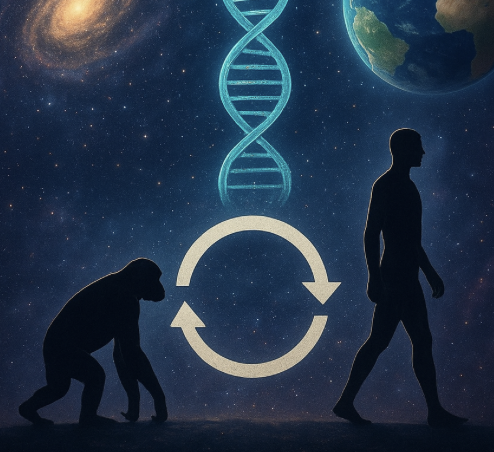
Yes: Any V3 can become pregnant.
Yes: Parents can influence the DNA of the new individual – or leave it entirely to chance.
You can also do the mailing yourself, but it's not mandatory.
Interpersonal relationships remain central. Conflict and deception are virtually unknown. This is not due to ideology, but because a high level of intelligence and intellect renders such behaviors unnecessary. Existential anxieties have been unknown for hundreds of millions of years. Humanity's focus is on preserving the Earth and its neighboring planets and cultural treasures, as well as on sustainable, shared progress.
Partnerships are diverse, flexible, and subject neither to religious nor state order.
A detail from the novel:
Seth initially identifies as male – and then as female in the middle of the story. This has gone unnoticed by most readers so far.
Gender conflicts and discrimination no longer exist.
Not because they were suppressed, but because they **no longer have a function**.
Reader questions: Food V3? How do V3s absorb energy? ^^^up
Yes.
But here too, the following applies: Anyone who asks this question is still thinking in a biologically limited way.
V3 absorb energy. Food is only **one** of several forms.
Organic food can still be consumed. It no longer primarily serves survival, but rather experience, culture, and memory. Taste, texture, ritual – all of this still exists. The difference: The ingested food is **completely utilized**. There is no longer any waste. Loss is a concept of the past. Efficiency is not a goal, but a standard.
The V3's actual energy balance, however, is not based on chemical combustion. Energy is **directly absorbed**, stored, and regulated. Each structure is a temporary storage unit, not a fragile system. Energy transmitters are integrated into all walls, ceilings, and floors of the honeycomb structure. The energy supply is primarily via **induction**, permanent, gentle, and stable. Discharge is practically impossible, as the energy flow is organized across a surface rather than at a single point.
The Earth itself is part of this system.
Beneath its crust, the magma mantle was tapped to convert thermal energy into electrical energy. But that is no longer the core of its power supply. A hollow ring was created in the planet's interior – with a diameter of over 12,000 kilometers. Driven by magma, it generates a stable plasma flow. This structure provides virtually unlimited energy. Not speculative, not symbolic – purely physical.
Traditional power lines still exist, but they are the exception. The norm is inductive, free energy transmission. Free of charge. Location-independent. Not rationed.
Currency was abolished long before. Not out of idealism, but as a logical consequence. The Earth provides more raw materials and energy than any single species could ever consume. Scarcity no longer exists. And without scarcity, greed loses its purpose.
Since the V3's existence, there has been no known case of individuals attracting attention through hoarding, compulsive collecting, or the accumulation of possessions. Not because it's forbidden – but because it **no longer makes sense**. Possessions create no security, no status, no meaning.
The V3 mindset – especially among creative individuals – is not focused on consumption, but on **creation**. Energy is not "consumed," but used. Resources are not hoarded, but transferred into projects: ecological stabilization, planetary architecture, knowledge preservation, cultural reconstruction, long-term goals beyond individual generations.
Sustainability is no longer a moral concept. It is a **systemic given**. A species that destabilizes its own energy source would have disqualified itself. The V3s do not rank themselves above other life forms, but rather **within a larger balance**. Humanity no longer sees itself as a user of the Earth, but as part of its functioning.
Goals are not achieved individually, but synchronously. Competition has become meaningless because progress is no longer exclusive. Creativity serves not to differentiate, but to expand what is shared.
So the V3 is still eating.
But he is no longer hungry.
Not looking for food.
Not based on energy.
And above all: not according to importance.