

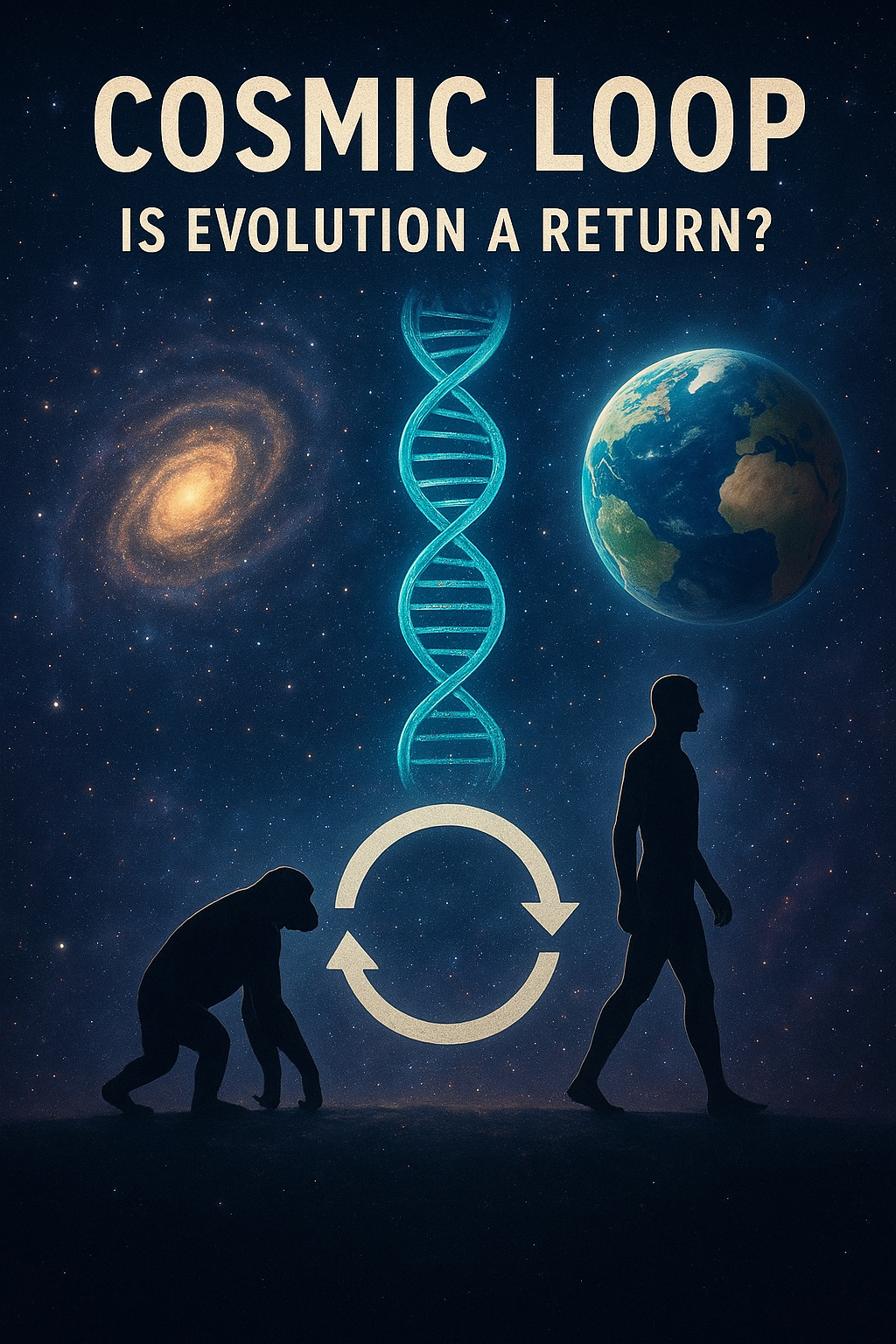
Cosmic Loop – is Evolution a return?
- 1. The Question of “Being” – A Thesis
- 2. Why is Nature Merciless?
- 3. Programs of Nature – and Their Fragments
- 4. Tools: The Evolutionary Weapon of the Creative
- 5. The Next Step: Artificial Intelligence as a Thinking Tool
- 6. What Does Mother Nature Want?
- 7. Limits of Our Body – and Our Time
- 8. Die or Survive: Two Paths for “Being”
- 9. An Attack on Faith or Politics?
- 10. Final Thought
- 11. Footnotes
The Question of “Being” – A Thesis ^^^up
1. Billions of years ago, two programs came together – biologists would say: a female and a male DNA. With the goal of creating something new – something faster and more adaptable than its parents. Looking back those billions of years, there was no “nature” yet, only elements. Water probably played a central role in the “first birth.” In this liquid, two tiny program fragments repeatedly met, merged, and created something new. Evolutionary biologists call this primordial being LUCA – the Last Universal Common Ancestor. It is thought to have originated on Earth about 4 billion years ago.
I simply call this principle “Nature.”
It’s likely that not always the same type of pairs met – this explains the diversity that arose and continues to arise. And the law of this development we still call today: Law of Nature.
It states bluntly: the new must be faster and more adaptable – or it ends up on the extinction list. Evolutionary biology knows many developments that did not meet these requirements – one of them we all know: the dinosaurs.
Why is Nature Merciless? ^^^up
2.
Evolution follows no moral compass, no ideal, no goal in the classical sense – but rather the principle of adaptation to change. Time is a limiting factor here. On a cosmic scale, the clock ticks mercilessly.
Programs of Nature – and Their Fragments ^^^up
3. Where do these “program fragments” come from, which repeatedly reassemble? DNA, RNA, cell structures – all these information systems have grown in complexity over time. Their ability to recombine became ever more sophisticated.
Water is no longer strictly necessary today – a bed suffices. During sexual intercourse, female and male DNA meet and create the next generation of humans.
We did not descend from apes – at least not directly. We share a common ancestor with the great apes. Our true family tree stretches back 4 billion years. Compared to the rest of nature, we have always been faster, more adaptable – yes, we even outlived the dinosaurs. Mother Nature has not yet put us on the list.
Tools: The Evolutionary Weapon of the Creative ^^^up
4. After the age of the dinosaurs, the creatives climbed down from the trees. Our eyes became more precise, our hands more sensitive. We began to use tools – first natural ones, then ones we developed ourselves.
From the arrow, to kill more efficiently, to the wheel, to travel faster. From fire, to cook, to steel, to protect ourselves. Today we build shelters that can withstand even atomic explosions. And that was only the beginning. More on this in my text "Earth 3.0".
The Next Step: Artificial Intelligence as a Thinking Tool ^^^up
5. In recent decades, we have begun creating tools beyond mechanics: Artificial Intelligence.
This tool is not an extension of our muscles, but an expansion of our mind. It is not a “merge” on the physical level – like an implant or prosthesis – but a thinking merge: a connection between human intelligence and machine computing power.
The goal is clear: acceleration of thought.
Data has been fed into the Internet en masse for years – we want to understand it all.
Now. Immediately.
The creative and the fast move ahead – the rest do not.
Nature once again sets an evolutionary milestone.
This perspective is also shared by modern thinkers:
What Does Mother Nature Want? ^^^up
6. What is the goal? Why this merciless dynamic?
Perhaps “Nature” – if we attribute a will to it – wants to bring something from the past back to life.
Did something exist billions of years ago that perished – scattering fragments of its program throughout the universe – and is now doing everything possible to recreate or reinvent itself?
This is not a scientifically provable assumption – but a philosophical hypothesis. Yet it is fascinating. Perhaps evolutionary processes contain more than just chance and selection. Perhaps there is a higher impulse: return through progress.
Limits of Our Body – and Our Time ^^^up
7. Our biology is now a bottleneck: language – through mouth and ear – is too slow.
Our brain – 1.4 kilos of nerve tissue – can no longer keep up with the speed of modern information flows. Our body is not made for outer space. Not even for the deep sea on our own Earth. It is an evolutionary interim stage. A transitional model. An obstacle.
So what remains, what truly matters?
Not the outer form – but our “being.” Some call it consciousness, others call it soul.
Die or Survive: Two Paths for “Being” ^^^up
8. Some will choose to die when their biological clock runs out – to give up their “being.” A loss for nature, a loss for progress and its speed. But since the invention of language, writing, digital storage – and teaching (passing on what is learned) – we have been working to preserve this knowledge, this “being.”
Or we manage to take the next step – and become immortal.
We connect everything. And accelerate further.
More on this in my text "Human 3.0".
An Attack on Faith or Politics? ^^^up
9. Is this thesis an attack on the thousands of faith institutions or on political systems of today or yesterday?
No. Faith and politics – just like culture and morality – are societal tools. They fit perfectly into the picture of evolutionary development. All have been – and are – necessary drivers to create, stabilize, or also change social structures.
But ultimately, they too are subject to what we have described as the law of nature:
What is not flexible, what cannot learn, is replaced.
What remains rigid breaks.
In this sense, faith and politics are also part of a greater evolution – one that encompasses cultural, biological, and technological dimensions. Not as a contradiction to nature – but as an expression of its dynamism.
Final Thought ^^^up
10. Perhaps we are here to bring something lost back to life – even if, as some scientists claim, we live in a cosmic loop that repeats every 100 billion years. At the moment of death?
I would choose immortality – as soon as the right tool exists – and you?
Footnotes ^^^up
Quammen, David. The Tangled Tree: A Radical New History of Life. Audiobook: audible.de/pd/The-Tangled-Tree-Hoerbuch↩
Harari, Yuval Noah. Homo Deus; Kurzweil, Ray. The Singularity is Near;
Bostrom, Nick. Superintelligence ↩